Grassroots To Greatness: Empowering Girls in Northern Nigeria
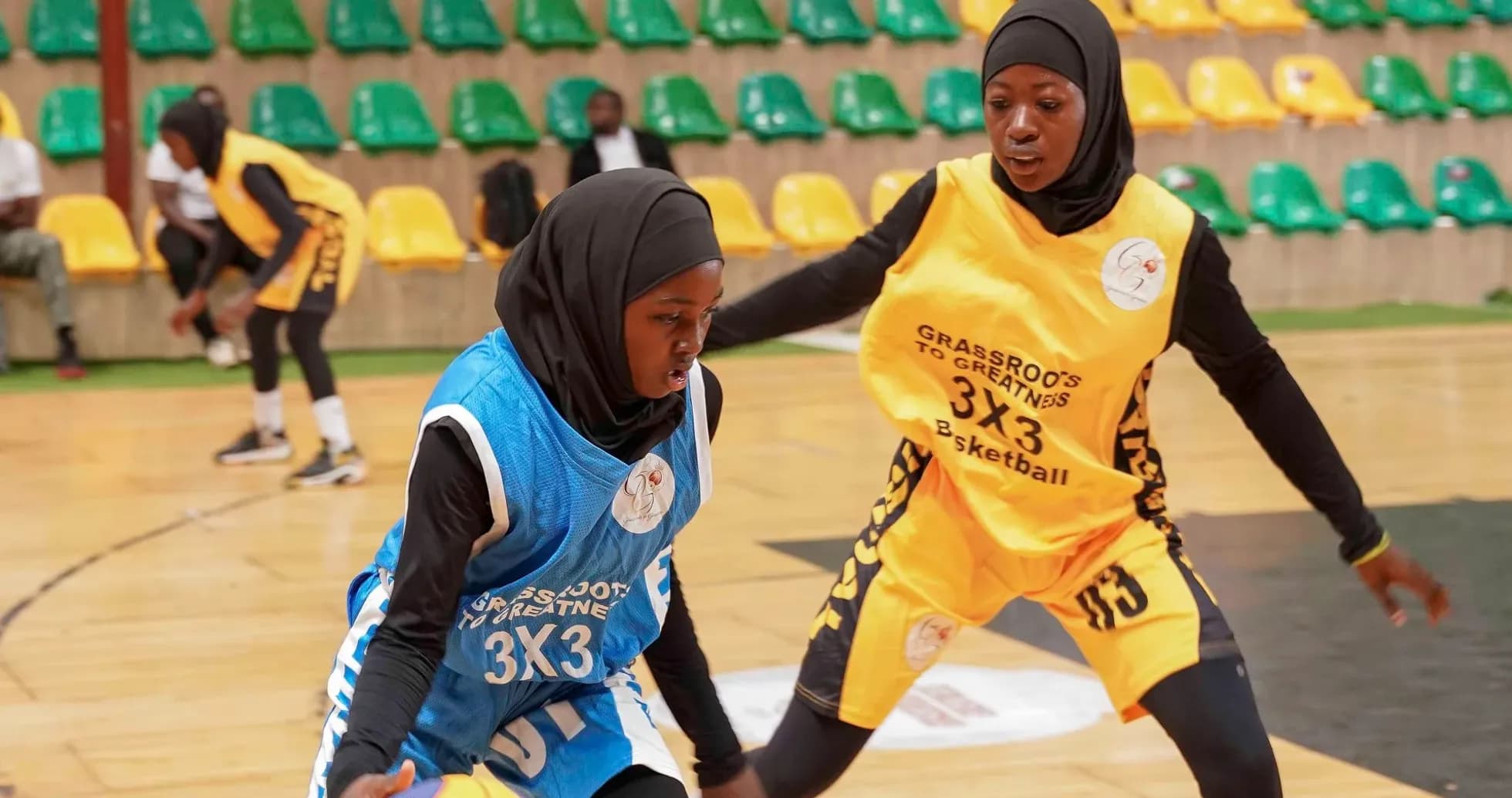
Abuja, Nigeria – In Kano State, where dusty courts sit behind school blocks and boys usually claim the space, Khamila Sani Ibrahim learned early that basketball for girls came with conditions.
Not the kind written in rulebooks. The kind enforced by glances, questions, expectations.
“It is very hard for me to train in basketball,” she said. “I only go out to play when they are not around, or I tell them that I’m going to visit my friends, and from there I go to the court.”
For years, that was the reality across much of northern Nigeria. Basketball and football were arenas for men and boys. Girls who wanted in had to navigate limited access to courts and equipment, almost no tailored coaching, minimal funding and very few competitive games. The talent was there. The pathway wasn’t.
Now, a different kind of project is drawing new lines on those same courts.
A new lane for girls
Grassroots To Greatness (G2G) is not a federation, not a big corporate-backed programme. It is a deliberate intervention, built for girls who have been told that sport is not their space.
Youth sports advocate Jawahir Bello started it after watching too many tournaments where girls were either missing entirely or treated as an afterthought. G2G flipped the script: female-only competitions, community training sessions and a structure that speaks directly to the cultural realities of northern Nigeria.
At G2G tournaments, the visual is striking. Players run the floor in custom hijabs, long sports vests and athletic tights. No compromise, no apologies.
“Our core value is about participating in sports without doing anything that goes against our cultural values or our identity as Muslims,” Bello told Al Jazeera. “Whether you put on a hijab or innerwear under your jersey, modesty is key. You come out modest, decent and fully covered.”
She expected pushback. Female-only tournaments. Girls sprinting, defending, shouting on the court. In many places, that alone can trigger resistance.
Instead, something else happened. Community stakeholders – religious figures, parents, local organisers – began to show up not to shut it down, but to watch. To ask questions. To support.
G2G’s method is simple and effective: work with the people already trusted on the ground. The programme partners with grassroots coaches who run community teams, using their local knowledge to identify girls who want to play but have never been given a real chance.
A tournament that changed the picture
For Ibrahim, that chance came when she represented Kano State in a multi-state G2G tournament that drew female players from up to nine different states.
She had played before, mostly with boys, often as the girl who had to prove she belonged every time she checked into a game. This felt different.
“What G2G did for us was incredible,” she said. “They provided jerseys, custom hijabs, basketballs, cover for our transport and even financial stipends for all the teams, regardless of who won or lost. It made us feel seen and valued.”
The details matter. Equal stipends. Proper kit. Travel covered. Those are signals: you’re not a token addition, you’re part of the main event.
In Abuja, 11-year-old schoolyard games were the starting point for another player, Fatima Diouf. She picked up a ball at school, discovered she loved the sport and then stepped into G2G to see how far her game could go against tougher opposition.
Her team did not reach the final. That wasn’t the story she took home.
“I have learned a lot beyond just basketball. I learned teamwork, confidence, discipline and how to keep improving,” she said.
The scoreboard closed. The lessons stayed open.
The weight beyond the baseline
None of this erases the daily grind that girls like Ibrahim face.
She still has to fight for time on the court. She still hears the dismissive comments from male players who assume girls can’t match their level. She still walks a tightrope between domestic chores, schoolwork and training sessions that demand energy she has already spent at home.
Self-doubt creeps in. So does fatigue. Yet she keeps going.
From the sidelines, experienced eyes see why initiatives like G2G matter.
Mansur Abdullahi, assistant coach of Nigeria’s U-20 women’s national football team, the Falconets, understands the gap between big sporting institutions and the streets where most careers begin.
“Official sports bodies have big structures, but local groups provide the actual trust and cultural understanding,” he said. “So it’s only through community-led initiatives that more professional teams will understand what’s acceptable for girls and boys and how to frame sports so it fits the existing values instead of clashing with them.”
That is the quiet battle: not just for facilities and funding, but for language, framing and acceptance. Making sport feel like it belongs inside the community, not outside it.
Dreams that cross borders
For many girls in G2G, these tournaments are more than weekend events. They are windows.
New opponents. New cities. New possibilities.
Before G2G, Ibrahim’s biggest challenge wasn’t a defender. It was at home. Her father feared that competitive sport might erode family standards and religious values. The idea of his daughter travelling to play, wearing a jersey, competing in front of crowds – it raised questions.
Then he came to watch.
He saw the uniforms: modest, carefully designed. He saw the structure: female-only competitions, clear rules, organisers who respected the same values he held. He saw his daughter, confident and composed, leading plays on a court that finally looked like it had space for her.
His stance changed. He became one of her strongest supporters.
Now Ibrahim thinks beyond the local court.
“I want to secure a college sports scholarship in the United States and eventually turn professional. More than that, I want other Muslim girls across northern Nigeria to see that sports build your health, strength, and confidence, and that nothing should hold you back from chasing your dreams,” she said.
For Diouf, the impact was just as profound, if different in shape. Watching the network of coaches, organisers and stakeholders converge at the tournament expanded her vision. She began to imagine herself not just as a standout in Abuja, but as a player who could travel, compete and represent across Africa.
The ambition is contagious.
Holding on to identity, claiming space
G2G is not content with staging the occasional girls’ tournament and calling it progress. The aim runs deeper: to plant the idea, firmly, that girls have a permanent place in sport – as players, coaches, organisers, leaders – without being asked to shed their identity.
Bello’s message is direct.
“You can keep your identity, stay covered and still achieve something in life,” she said.
On courts across northern Nigeria, that sentence is starting to look like a game plan. The question now is how many more girls will step over the sideline and into the light, and how quickly the rest of the sporting world will adjust to meet them there.