
Germany Dominates Serbia 3-1 in Nations League Clash
The Nations League is not supposed to matter. Not really. Yet in Belgrade, under the lights and under pressure, Jürgen Klopp’s Germany played as if something far bigger than group-stage points was on the line.
They dismantled Serbia 3-1 away from home, a scoreline that flattered the hosts more than the visitors. This was controlled, aggressive, almost suffocating football from a side that has too often looked lost in recent years. Here, though, some familiar names and one very new one dragged the shirt a little closer to its old weight.
A Right-Back and a Bigger Question
There was no Serbia player worthy of a figurative jersey swap. Not on this night. Srđan Babić scored at the wrong end, Kosta Nedeljković repeatedly allowed Florian Wirtz the freedom of his flank. Serbia never really convinced anyone they were ready to fight their way back.
So the conversation circles back to Germany’s own problem position: right-back.
Philipp Treu embodies both the progress and the ceiling of this team. The Freiburg defender never stopped running. He hunted the ball, chased lost causes, covered ground like a man who knows his opportunity is fragile. Defensively and in pure work rate, he belongs.
Then he wins the ball and the picture blurs.
Treu’s limitations in the attacking phase are stark. His recovery runs are excellent, his positioning often sound, but once he steps into the final third, the ideas dry up. The modern full-back is expected to be a playmaker, a winger, a spare midfielder. Germany’s best current option on that side still looks like a throwback.
That is not a plea to discard him. It is a question that cuts deeper: how has a football nation that wants to dominate the ball and impose itself still not produced a complete right-back for this role? Klopp will need a tactical workaround, because his system extracts every ounce of Treu’s intensity. It just cannot yet turn that effort into consistent end product.
Thiaw Plants a Flag at the Back
At centre-back, though, Germany may finally have solved a problem that has lingered for a decade.
Malick Thiaw started because Klopp expected Serbia to go long. He wanted an aerial specialist, so Nico Schlotterbeck sat and the Newcastle defender stepped in. It looked like a pragmatic call. It ended up feeling like a statement.
Thiaw dominated in the air, as advertised, but his performance went well beyond heading clear. He attacked two chances of his own with his head, one from a set-piece, another in open play, hinting at a threat at the other end. More striking was what he did with the ball at his feet.
At times he seemed to borrow from Joshua Kimmich’s playbook: calm on the ball, deliberate with his passing, rarely rushed. He held possession under pressure, picked his moments, and cut out the errors that have haunted recent German defences. On the ground or in the air, he won his duels, took only a single yellow card, and never looked rattled.
By the final whistle, the idea of Schlotterbeck as an automatic starter felt a little less certain. Thiaw, alongside Jonathan Tah, played the full 90 minutes and never loosened his grip on the game.
Kimmich, the Quiet Conductor
Germany had 79% possession. That statistic alone tells you where this match was played. The reason it felt like a training exercise in control has a familiar name.
Joshua Kimmich did not need a highlight reel to dominate. He rarely does. His passing angles, his tempo, his ability to always offer a safe option or a progressive one, kept Serbia chasing shadows. The captain stitched together almost every phase of German play.
Two moments defined his night.
First, Brajan Gruda’s goal. Kimmich drifted to the right, linked play, and triggered the passing sequence that freed the debutant to finish. It looked simple. It never is. His awareness of space, of when to overload a flank and when to recycle, turned half-chances into real ones.
Second, his partnership with Aleksander Pavlović. This double pivot carried a strong Bayern echo and a clear Klopp imprint. Pavlović’s composure and balance allowed Kimmich to roam, to step wide, to dictate. The pair contrasted and complemented each other so naturally that it felt less like an experiment and more like a blueprint.
On this evidence, it should be Germany’s default.
Wirtz Finds the Space – and Himself
Florian Wirtz walked into a gift of a game. Serbia, inexplicably, decided not to mark him with any real conviction. For a player of his intelligence, that is an invitation, not a mistake.
He seized it.
Wirtz is not a classic No. 10 who stands between the lines and waits for the ball. He drifts, he rotates, he appears in pockets that defenders hate to track. Unmarked, he kept slipping into gaps, offering himself for line-breaking passes, turning and driving at a retreating back line.
The numbers will never quite capture what he does. His movement dragged Serbian players out of shape, opened corridors for runners, and constantly asked new questions. He took shots, he linked play, he stretched the game horizontally and vertically.
This was not Serbia at their best, and that has to be said. Yet Wirtz showed exactly why so many once called him Germany’s golden boy. If his confidence holds and performances like this become the norm, that label might return.
Gruda’s Debut, Gruda’s Night
Then came the moment that will live far longer than this Nations League tie.
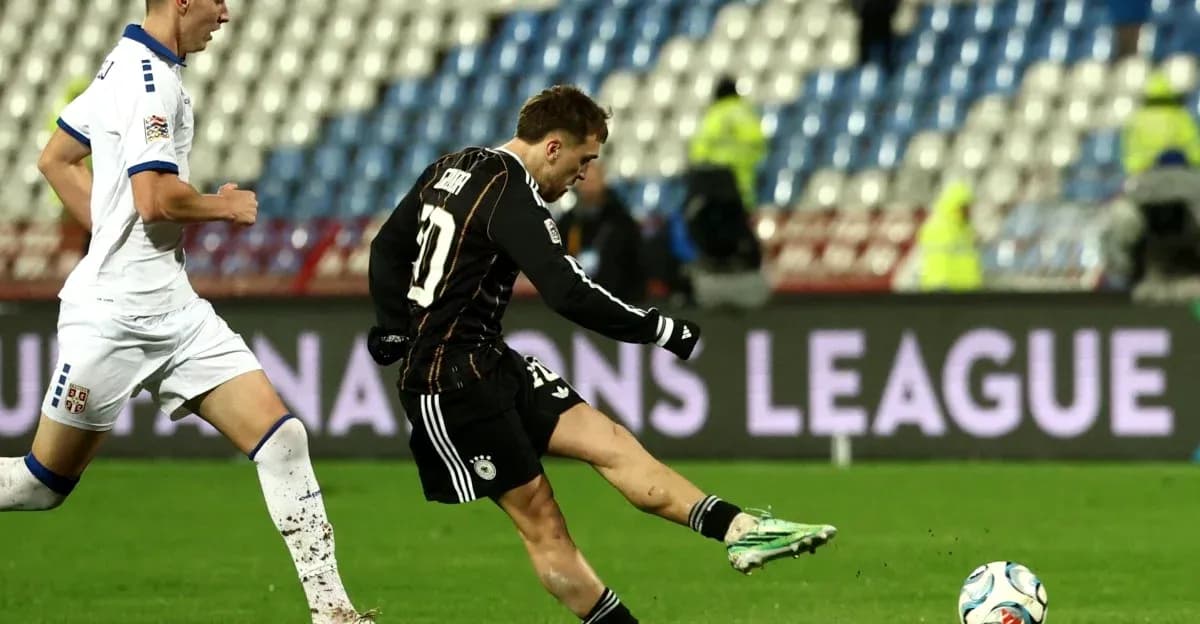
Brajan Gruda, making his senior debut, picked up the ball in his own half. What followed was the kind of run that silences a stadium. He surged past the Serbian midfield, glided beyond defenders, and, just outside the box, unleashed a sharp, precise shot into the corner.
That was the goal that broke Serbia. That was the goal that announced him.
Gruda has already flashed his quality on loan at RB Leipzig, particularly in a standout display against PSV Eindhoven. Klopp saw enough there to bring him into this squad. In Belgrade, the 22-year-old repaid that faith with interest.
He played with a fearlessness Germany have often lacked. With Kimmich ensuring the ball kept coming back to German feet, Gruda provided the vertical chaos: direct running, relentless duels, one-on-one wins. At times he bordered on over-aggressive, but for a team that has drifted into passivity too often, that edge felt like a feature, not a flaw.
On a night when Klopp’s tactical plan shone and several established names impressed, it was the debutant who outclassed every other attacker on the pitch. That is why, if you had to pick one figure to define this win, it would not be the coach.
It would be Brajan Gruda, sprinting through Belgrade, ball at his feet, and a new Germany at his back.





