Gabriel: Manchester United's Teenage Prodigy at the Center of Transfer Chaos
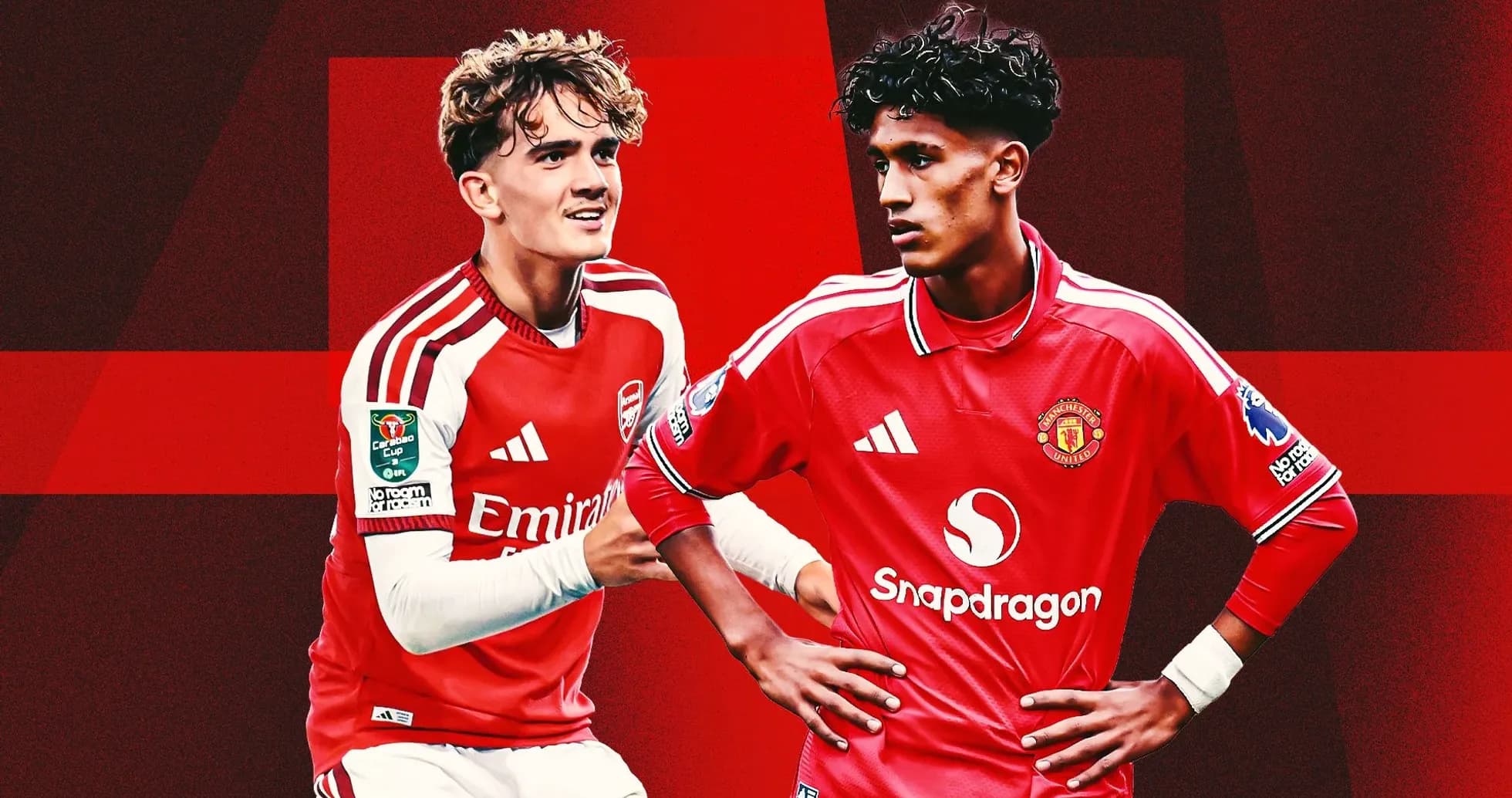
Gabriel, Manchester United’s teenage prodigy, has become the centre of a transfer storm that cuts right to the heart of what the club wants to be.
Real Madrid want him. Barcelona want him. Paris Saint-Germain and Bayern Munich are circling too. Four of Europe’s giants, all chasing a boy who still isn’t old enough to sit his GCSEs.
United, though, are digging in. They have no intention of letting him walk away.
A 15-year-old at the eye of a European tug-of-war
Inside Old Trafford, senior figures are working overtime to change Gabriel’s mind. They know what losing him would look like. INEOS chairman Sir Jim Ratcliffe has already felt the heat from supporters over a series of unpopular calls. Letting a once-in-a-generation academy talent slip away would turn the temperature up again.
On paper, United hold the contract. Gabriel is tied down until next summer. In reality, the situation is far more fragile. He is not a full-time scholar, not part of the club’s full-time model, and the clock is ticking towards October 16, when he turns 16.
That date matters. Under post-Brexit rules, if Gabriel has a European passport, he can walk away as a free agent to any club in the EU before he turns 18. United are now combing through his family background for answers.
His father, Joe O’Cearuill, is a former professional who played twice for Ireland. His mother is of Greek Cypriot heritage. Dual nationality would open the door to a move abroad and slam it in United’s face.
They kept him away from Manchester City’s grasp last year. This fight feels tougher. It may already be lost.
The no-show that set alarm bells ringing
The first real warning sign came at the weekend. Gabriel was scheduled to train with the first team on Saturday. A huge step. A clear sign that Michael Carrick was ready to bring him closer.
He didn’t turn up.
He has not been seen at Carrington all week.
Carrick had pencilled him into the squad for Wednesday night’s Carabao Cup third-round tie against Brighton at Old Trafford. If Gabriel had made it onto the pitch, he would have become the youngest player ever to represent United’s senior side.
That piece of history is gone. His involvement has been ruled out.
For a club whose academy has not produced a genuine global superstar since Marcus Rashford, Gabriel has been the great hope. A two-footed forward who glides out of tight spaces, shifts direction in a heartbeat and finishes with cold precision. The kind of player who makes youth coaches whisper about destiny.
The Neymar echoes and a record-breaking rise
The Lionel Messi comparisons do him no favours, and everyone around him knows it. Stylistically, he is closer to Neymar – that same slaloming gait, that same love of taking defenders on in uncomfortable areas.
He even wears the same model of Nike boots as the Brazilian, having signed a lucrative extension with the sportswear giant in March 2025. The branding machine has already found him.
The numbers back the hype. Last season, at just 14, he broke into United’s Under-18s – another record – and tore the league apart: 20 goals in 21 games. That haul earned him the inaugural Premier League U18s Player of the Year award and United’s Jimmy Murphy Young Player of the Year prize, making him the youngest winner of both.
By August he had stepped up again, this time to the U21s. On debut against Ipswich, he produced two assists and a deft chip in a 5-0 rout. A week later, he scored again as United hammered Leicester City 4-1.
This is not a normal trajectory. This is a teenager sprinting through age groups, barely pausing for breath.
No wonder there is a clamour for Carrick to unleash him, especially with United’s senior side crying out for spark in the final third, and with Max Dowman’s rise at Arsenal fresh in everyone’s mind.
The Dowman effect – and the Premier League’s new kids
The Premier League has already seen what happens when a club backs a special teenager and gets the timing right.
In 2022, Ethan Nwaneri became the youngest player ever to feature in the league when he came on for Arsenal against Brentford at 15 years and 181 days. His path since has been uneven – loans to Marseille and Borussia Dortmund, spells of frustration – but he now has over 50 appearances for Arsenal and remains just 19.
Arsenal have doubled down on the idea that “if you’re good enough, you’re old enough”. Dowman is the latest proof. He became the league’s second-youngest player when Mikel Arteta threw him on against Leeds in August 2025. In March, he broke James Vaughan’s record as the Premier League’s youngest scorer with a brilliant solo strike against Everton at 16 years and 139 days.
By May, he was the youngest title-winner in Premier League history. This week, he joined Wayne Rooney in an exclusive club, becoming only the second 16-year-old to score a brace for a Premier League side in a major competition, steering Arsenal to a 4-2 Carabao Cup win over Ipswich.
Fourteen senior appearances already. A blend of flair and physical presence that makes him impossible to ignore. Arteta has spoken his name in the same breath as Messi, then carefully dialled down the noise by managing his minutes with forensic care.
“We have to look after him. He's 16 years old. You don't see that in this league,” Arteta said after the Ipswich game, stressing the unique physical and mental demands of English football and the need to drop Dowman into the right situations at the right time.
Why United can’t copy Arsenal’s playbook
Gabriel does not have Dowman’s frame. He is slight, often the smallest player on the pitch. His bravery and resilience close some of that gap, but they don’t erase it.
Throwing him into United’s first team too early could backfire badly – and not only if he struggles.
If he makes an instant impact, Carrick will be under relentless pressure to keep picking him. A 15-year-old suddenly shouldering the burden of a club in transition. A young body dragged through the Premier League grind week after week.
Arteta can dip in and out with Dowman because Arsenal’s squad is deep, balanced and winning. He can change half his outfield players and still expect to dominate games.
United are not in that place. Their performances lurch from one extreme to another. If Carrick were to pull Gabriel out after a run of games, he’d be accused of stifling a talent the fans are desperate to see. If Gabriel came in and looked raw, he’d be written off by some as overhyped.
This is why Carrick’s caution has impressed those who know the club’s academy best.
Voices from the past: why timing matters
Danny Simpson, a United academy graduate who emerged at the tail end of Sir Alex Ferguson’s golden era, believes the manager is handling it correctly.
Speaking to GOAL courtesy of Free Bets, Simpson drew a sharp contrast between Dowman’s environment at Arsenal and the one Gabriel would walk into at Old Trafford.
He recalled how he could ease into games because United were so strong. He would come on for 10 minutes when they were already 2-0 or 3-0 up, often surrounded by a so-called “second XI” that was good enough to win the league. That, he argued, is Dowman’s reality now: entering a side full of confidence and elite talent, where even the backups are high level.
United today are different. Far less margin for error. Far less protection for a teenager trying to find his feet.
Simpson urged patience. Let Gabriel train with the first team. Let him feel the rhythm of senior football. Let his time come naturally.
He pointed to Shea Lacey as another example of careful integration. Lacey has trained with the seniors, dipped in and out, and been shielded from overexposure. Simpson believes the same approach should apply to Gabriel.
The Yamal temptation and the lure of Spain
Yet it is hard to tell a 15-year-old to be patient when he looks around Europe and sees his peers already living the dream.
Even if Gabriel accepts that his situation is different to Dowman’s, he will look at Lamine Yamal at Barcelona and feel the pull.
Yamal made his Barcelona debut in 2023 at 15 years, nine months and 16 days. He was as skinny as Gabriel is now, as physically vulnerable, but his acceleration and intelligence helped him navigate La Liga’s more technical, less bruising landscape.
Spain’s top flight demands tactical discipline and ball retention rather than the ferocious, end-to-end chaos of the Premier League. It is a kinder environment for a teenage technician.
In England, where time on the ball is a luxury and contact is constant, Yamal might not have exploded so quickly. In Barcelona, the conditions were perfect.
Gabriel may look at that and think Barca or Real Madrid can fast-track him to superstardom. On one level, it makes sense. On another, it ignores the importance of timing.
When Yamal broke through, Barcelona were on their way to the La Liga title under Xavi but had just crashed out of the Champions League in the group stage. Raphinha, Ousmane Dembele and Ferran Torres were still finding their level. There was room for disruption.
Now, Barcelona’s forward line is packed: Yamal himself, a peak Raphinha, Anthony Gordon, Karim Adeyemi, Gabriel Jesus. Real Madrid are even more stacked, with Jose Mourinho able to call on Kylian Mbappe, Vinicius Junior, Jude Bellingham and Yan Diomande.
Where, exactly, does a 16-year-old Gabriel fit into that? He would still be waiting, still fighting for scraps of minutes, only in a foreign country with higher stakes and less tolerance for growing pains.
The power struggle United refuse to lose
Wherever he goes, Gabriel will have to wait. The irony is that his clearest route to regular senior football lies at United, the club he joined at 11, the club that has built him up and sold him a dream.
If he insists on having everything immediately, he risks losing the very platform he needs.
United, for their part, are drawing a line. They cannot allow themselves to be held to ransom by a 15-year-old, no matter how gifted. Not when he is still 18 months away from his GCSEs.
Carrick and the academy staff have guided him sensibly so far. They will continue to do so if he re-engages. If he does not, there is little value in a drawn-out saga that drains energy from a season already under strain.
The longer this drags on, the more it distracts from the team’s attempts to recover from a poor start. Whether pushed by family, advisers or his own ambition, Gabriel is making bold moves, fuelled by a sense of entitlement that has become uncomfortably familiar at United.
Entitlement, adversity and the old United standard
Ruben Amorim, the much-criticised former United manager, did not last long in the Old Trafford dugout. Yet one of his final observations still hangs over the club.
“There is a feeling of entitlement we have in our club,” he said shortly before his January sacking. Difficult moments, he argued, can be good for young players. They do not always need constant praise. They need to stay, fight, overcome.
His words echoed the journeys of United’s great homegrown icons. George Best, Sir Bobby Charlton, Ryan Giggs, David Beckham, Paul Scholes, Gary Neville – none of them were handed anything. They climbed through the ranks, took the hits, met the standards on and off the pitch.
Greatness, at this club, has always demanded suffering as well as talent.
Right now, Gabriel stands at a crossroads. With his current mindset, he is not ready to carry the weight of United’s shirt. Not because he lacks ability, but because he appears to be chasing the shortcut that does not exist.
No one is bigger than the club. If that lesson does not land, United may have to let him go and watch him build his personal brand somewhere else.
The question is simple, and it no longer belongs only to Gabriel: in an era of instant gratification and global suitors, does Manchester United still have the conviction to back its own standards over any single rising star?