Eto’o Ignites Refereeing Controversy in Cameroon
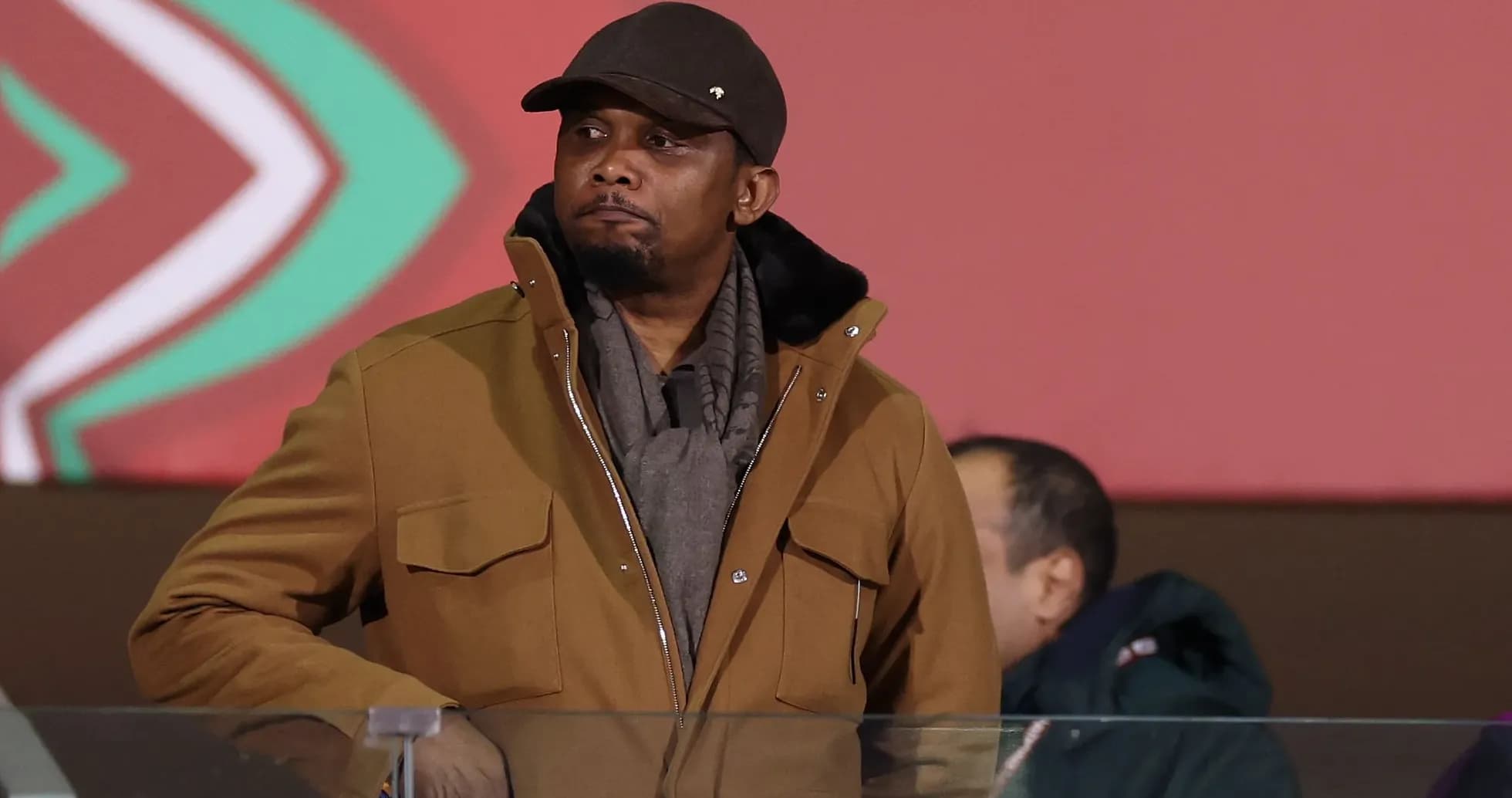
Samuel Eto’o has never been a man for quiet rooms. This time, his words have dragged Cameroonian refereeing into the eye of the storm.
At a graduation ceremony for a new intake of referees, the Cameroon Football Federation president stepped to the podium and issued a stark warning. He spoke of “certain individuals” the young officials would encounter in their careers. Then he sharpened the focus.
A “former referee and army officer,” Eto’o said, had played “negative roles” against Cameroon in past African competitions. The same man, he claimed, had also tried to “influence Morocco in favour of another country” and repeated similar behaviour during the most recent Women’s Africa Cup of Nations, when the Cameroon Lionesses were involved.
He offered no name. No dates. No documents. Just a serious allegation dropped into a charged room.
A pointed description, and instant speculation
Eto’o’s comments, relayed by Cameroonian outlet CFOOT, were vague on detail but precise enough in profile to ignite a guessing game. A former international referee. An army officer. Deeply embedded in the domestic refereeing structure.
The description immediately pushed one name to the forefront of public debate: Alioum Sidi.
Sidi is not only a former FIFA-listed referee and Cameroonian army officer; he now serves as president of the Association of Cameroonian Football Referees. Eto’o never mentioned him. He didn’t need to. The dots were easy to join.
Yet the federation chief stopped short of explaining what “influencing Morocco” meant in practice. No match was identified, no competition specified, no country named as the supposed beneficiary. The allegation hung in the air, heavy but unsubstantiated.
Alioum Sidi hits back
Sidi did not wait long to respond. He treated the remarks as a direct attack and answered with a statement that left no room for ambiguity.
The former referee “categorically” rejected any “accusation, insinuation or interpretation” suggesting he had tried to influence a match in favour of another nation or acted against Cameroon’s interests. For a man whose authority rests on impartiality, the charge strikes at the core of his professional identity.
So he pushed the ball straight back into Eto’o’s half.
Sidi demanded the federation president spell out the facts behind the claims and present “objective evidence” to support them. Without that, he warned, he would turn to the courts and to the relevant sporting bodies to protect his honour, reputation and integrity.
The threat was clear: this would not remain a war of words if Eto’o could not back his story.
A deeper power struggle
Behind the public clash lies a wider battle for control of Cameroonian refereeing.
Sidi himself pointed to the ongoing dispute between the Association of Cameroonian Football Referees and the Cameroon Football Federation, a case currently before the Court of Arbitration for Sport (CAS). The two bodies are already locked in a legal fight; trust is thin, patience even thinner.
In that context, Sidi framed Eto’o’s outburst as something more than a spontaneous warning to young officials. He linked it directly to the CAS dispute, describing the comments as a sign of “the federation president losing his composure” – a sharp, calculated jab at the most powerful man in Cameroonian football.
So a ceremony meant to usher in a new generation of referees has instead exposed the depth of a rift at the top of the game. On one side, a global icon turned federation president, accusing unnamed figures of sabotaging Cameroon and meddling with Morocco. On the other, the country’s leading refereeing voice, demanding proof and threatening legal action.
The next move may not come on a pitch at all, but in a courtroom in Lausanne.