
Eddie Howe: The Next Manchester United Manager?
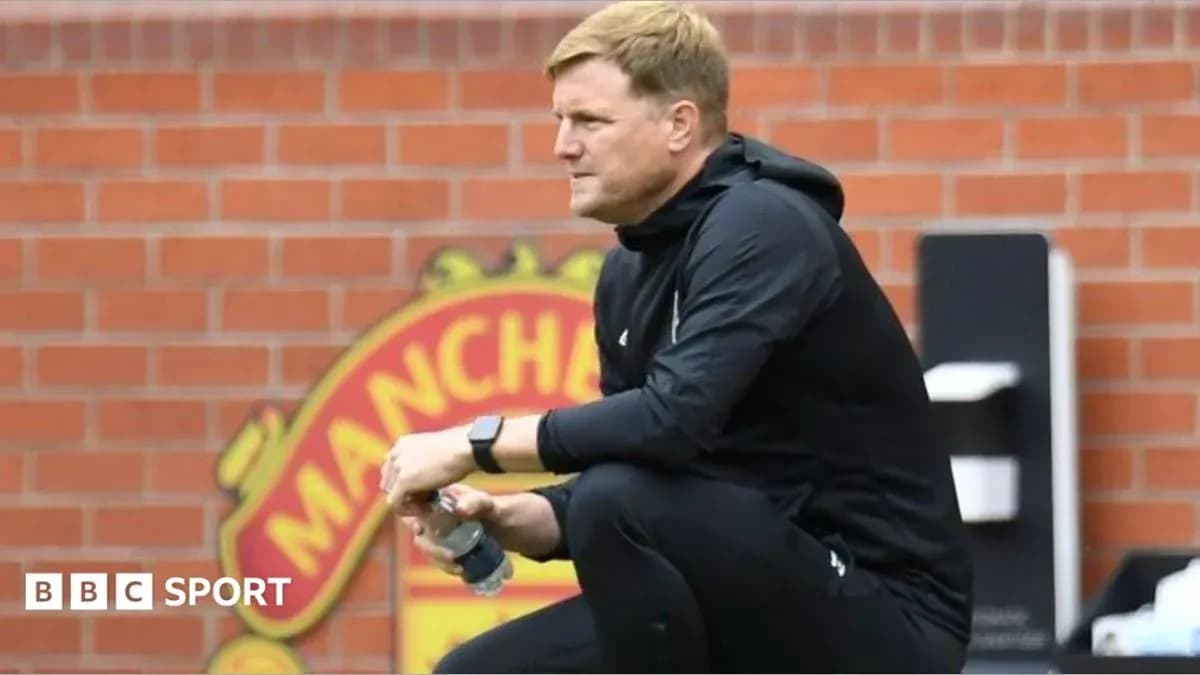
When Sir Jim Ratcliffe bought into Manchester United in early 2024, he sold a clear idea: a rebuilt club with a strong British core, on the pitch and in the dugout. The appointment of Michael Carrick as the first permanent British manager of the Ineos era looked like the embodiment of that vision.
Now, with United drifting and Carrick under severe pressure, that same vision is being tested.
Howe on the horizon
If Carrick cannot halt the slide – and Saturday’s meeting with Chelsea looms large in that regard – United’s hierarchy are already deep into the next question: who comes next?
Eddie Howe is not a speculative name thrown in from the fringes. He is firmly in the frame, a serious contender for one of the most scrutinised jobs in world football.
Those who have worked alongside Howe paint a consistent picture. They talk about a coach obsessed with the training ground, a manager who improves players not by accident but by design, through repetition, detail and an almost unforgiving intensity. They talk about someone who thinks constantly about culture, who believes winning habits are built long before a team walks out of the tunnel.
He has never managed one of England’s traditional “big six”, but his CV carries weight.
Bournemouth were staring at relegation from League Two when he took over in January 2009. By 2015, he had them in the Premier League. He didn’t just visit the top flight; he kept the club there and established the Cherries as a credible presence before leaving, for the second time, in 2020.
At Newcastle, appointed in 2021 with the club in trouble, Howe drove them away from the relegation zone and into the Champions League on two separate occasions. He also delivered the EFL Cup in 2025 – Newcastle’s first major trophy in 56 years. That is not the profile of a lucky caretaker. That is a body of work.
Manchester United, though, are another beast entirely.
Divided opinion, familiar noise
Howe’s emergence as a possible successor to Carrick has not been met with universal enthusiasm.
Sections of the United support have been blunt on social media: Howe, they argue, is not a big enough name for Old Trafford. For some, the badge demands a superstar manager as much as it does superstar players.
Even among the club’s former players, the response has been mixed. Paul Scholes and Nicky Butt stopped short of endorsing Howe on their podcast, despite having previously spoken positively about the idea of him taking over when Ruben Amorim was sacked in January. The nuance is there, but the full-throated backing is not.
Others see it differently. Roy Keane has publicly backed Howe as a viable successor to Carrick, and he is not alone. Darren Bent, Gareth Barry and Jack Wilshere are among the former top-flight professionals who have put his name forward as the right fit.
Look long enough and you can find advocates and detractors for any manager. That is the modern managerial market. The real judgement will be made not on social media or podcasts but in the offices where the power sits.
The decision-makers and the bill
Inside Old Trafford, the key figures are clear. Chief executive Omar Berrada, sporting director Jason Wilcox and director of recruitment Christopher Vivell will shape the recommendation. Ratcliffe, alongside co-chairs Joel and Avram Glazer, will sign it off.
Their first call is not Howe. It is Carrick.
If the former Middlesbrough manager goes, United must settle with him and his staff before they even begin to commit financially to the next man. Given the money already burned through on sacking managers in recent years, that matters.
Then comes the question of Howe’s own situation. The exact details of his agreement with Newcastle when he left in the summer remain private, but the broad framework is understood.
Any club or national team wanting Howe right now must pay compensation to Newcastle. Multiple sources have indicated that the deal was designed to protect the Magpies from seeing him walk straight into another job. The structure is tiered, with the fee dropping over time.
That figure is believed to have started at £6m and has already been cut in half. As things stand, the cost sits at a maximum of £3m. The clause has a shelf life, understood to expire before the end of the season. Once that date passes, Howe can be appointed for nothing.
In a sport where transfer fees routinely stretch into nine figures, £3m for a manager of Howe’s calibre is hardly eye-watering. Yet context matters. United’s recent outlay on changing coaches gives Berrada and Wilcox every reason to keep an eye on the bottom line.
A fork in the road
Within the football department, there is no single, unified view.
Wilcox is thought to favour Howe, attracted by his track record of building teams, his training-ground intensity and his ability to shape a club’s culture. Vivell, by contrast, is understood to prefer Julian Nagelsmann, the former Bayern Munich and Germany coach, a very different profile and a very different statement.
Those competing visions will land on Berrada’s desk. From there, the debate moves upwards to Ratcliffe and the Glazers, who must decide what kind of Manchester United they want to build.
The resistance to Howe among some supporters does not appear to stem from a single, clear source. Wilcox was targeted by fans during the 3-0 home defeat by Bournemouth, and that frustration has bled into suspicion of his preferred candidate. There is also a broader disillusionment among matchgoing fans over the football decisions taken since Ratcliffe’s minority stake was confirmed.
Erik ten Hag was backed. Ruben Amorim was backed. Michael Carrick has been backed. None has yet found a way to drag United consistently back to the elite level their supporters crave.
Bigger than one man
There is a harsher theory doing the rounds: that no manager can truly succeed at United while the current structure remains in place.
Whoever steps into the dugout inherits a squad stitched together by six permanent managers, each with his own philosophy, his own transfer priorities, his own tactical ideals. The result is a dressing room that feels more like a collage than a coherent project.
In another era, a manager like Howe might have been given years to shape a club in his image, as Sir Alex Ferguson did at Aberdeen before heading south in November 1986. The modern game rarely offers that kind of time.
So the question facing United is not simply whether Eddie Howe is good enough for them. It cuts deeper.
If they choose Howe, they are choosing a builder, a coach whose reputation rests on method, culture and incremental improvement. If they look elsewhere, towards a Nagelsmann or another headline name, they are signalling a different route: a bolder, perhaps riskier attempt to shortcut the process.
Either way, the decision will say as much about Manchester United’s identity under Ratcliffe as it does about any one manager.
And with Chelsea coming to Old Trafford and Carrick’s future hanging in the balance, that decision is getting closer by the day.





