Dejounte Murray's Trade Request Signals End of Era for Pelicans
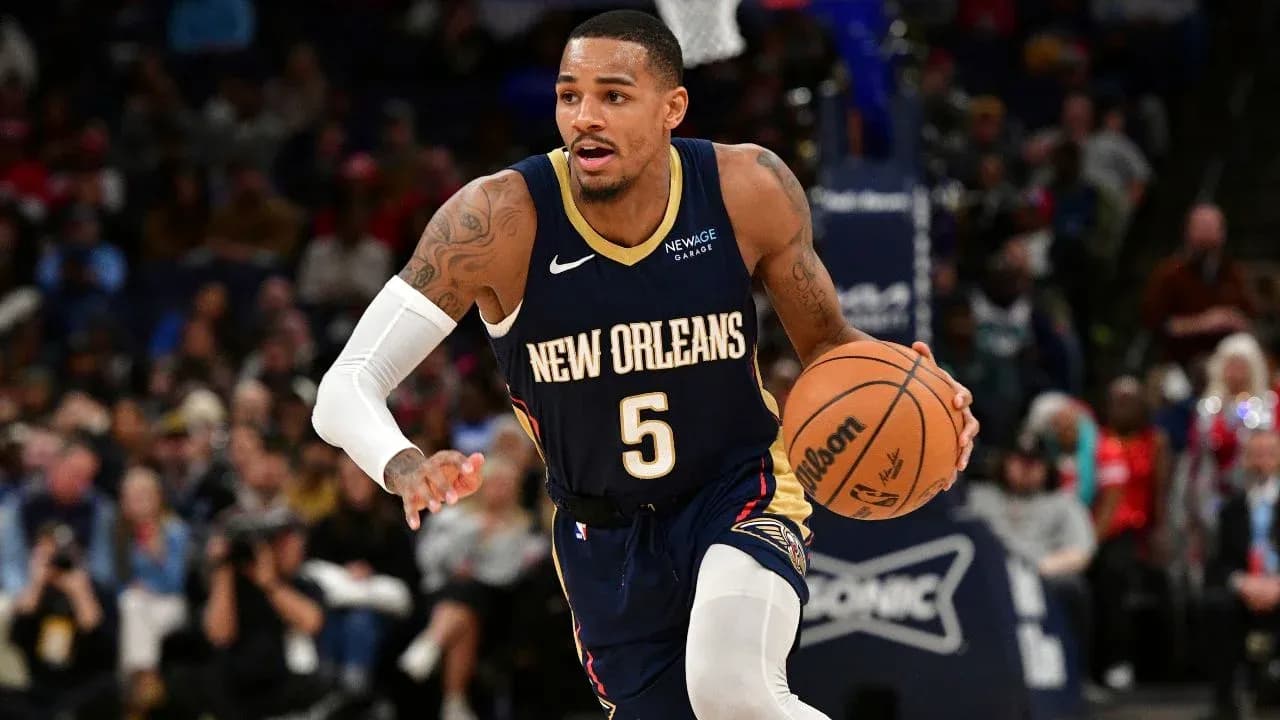
NEW ORLEANS — The Dejounte Murray era in New Orleans is ending with a thud, not a roar.
The Pelicans announced Friday that the 30-year-old guard has requested a trade through his representatives at Klutch Sports, and the franchise has agreed to explore a deal.
“Today, Dejounte Murray’s representatives informed us of his request to be traded,” the team said in a statement. “We will evaluate potential trade opportunities that are in the best interest of our organization.”
No soft landing. No attempt to dress it up. A marquee acquisition from just over a year ago now stands as one of the franchise’s most bruising miscalculations.
From centerpiece to problem to move on from
When New Orleans pried Murray away from the Atlanta Hawks in June 2024, the price screamed “franchise pillar”: two first-round picks, Dyson Daniels, Larry Nance Jr. and E.J. Liddell.
David Griffin, then the Pelicans’ executive vice president of basketball operations, sold the vision clearly. Murray, an All-Star in 2022, would be the two-way guard who could defend at the point of attack, organize the offense and ease the constant ball-handling burden on Zion Williamson.
On paper, it made sense. At the time of the trade, Murray was coming off a season of 22.5 points, 6.4 assists and 5.3 rebounds per game. A guard in his prime, on a team desperate for reliability in the backcourt.
Reality never matched the brochure.
Injuries, setbacks and a season that never really started
Murray’s Pelicans career never found rhythm. It barely found the floor.
He broke his hand in the 2024 season opener. When he returned, he struggled to find his timing, his shot and his place in the offense. Just as he tried to build some momentum, disaster struck again: a season-ending Achilles injury in January 2025.
Across three seasons, Murray has managed only 54 games in a New Orleans uniform. The numbers tell the story of a player stuck between what he once was and what his body will now allow: 16.6 points, 6.6 assists and 5.9 rebounds per game, but on just 41.9 percent shooting overall.
This season, the slide has been even starker. In nine games, he has averaged only 13.4 points, his efficiency sagging under the weight of missed time and mounting frustration.
On Friday night, he wasn’t just out of the lineup against the Memphis Grizzlies with a left ankle sprain. He wasn’t even in the building. Pelicans coach Jamahl Mosley confirmed Murray was not at the Smoothie King Center.
The frustration goes public
The tension didn’t stay in the locker room.
Murray’s discontent has spilled onto social media, where he has fired off pointed, critical posts about the team and its direction. The most striking came after a reporter highlighted that the Pelicans were 3-0 without him in the lineup.
Murray’s response was loaded.
“From what’s going on INSIDE, this sounds like someone hit you to say this! THE ‘SABOTAGE’ IS REAL!” he wrote.
The word “sabotage” doesn’t float harmlessly through an organization. It lands. It lingers. It forces questions about trust, roles and the internal temperature of a locker room already dealing with a four-game losing streak.
Mosley looks past the drama
Asked about a player demanding a trade while the team spirals, Mosley chose not to fuel the fire. He pivoted straight back to standards and identity.
“How well we play is very important to me, and making sure that we keep up that standard,” he said. “That’s why it’s so glaring when we don’t, because I know what this team has shown during training camp, what it has shown during the preseason.
“The first couple games didn’t go on the win column, but the way we played, we did a lot of good things. … As the leader of this group, how we’ve been playing these last three games have not been a representation of this organization, the city, of the way we said we were going to play. That’s been my focus over this last day or so. How do we get back to that style of basketball that we know represents this organization the right way?”
His message was clear: the Pelicans will not let one player — even a high-profile one — define their season’s narrative.
An expensive exit and a hard question
Murray is earning $32.8 million this season and holds a player option for $30.8 million next year. That contract, combined with his injury history and recent form, makes this more than a simple “trade request.” It’s a complicated puzzle for a front office that already pushed its chips in to get him.
New Orleans now faces the uncomfortable task of trying to recover value from a distressed asset it once viewed as a cornerstone.
The Pelicans will move on. They have to. But the real issue lingers over the franchise like a storm cloud: after all the upheaval and all the bets on co-stars around Zion Williamson, how many more swings like this can they afford to miss?