
Cristiano Ronaldo: Two Decades of Impact on International Football
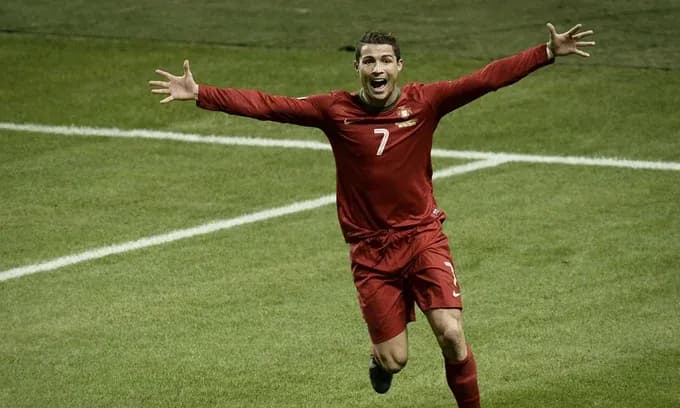
On a warm August night in 2003, an 18-year-old with bleached tips and a whirl of stepovers pulled on Portugal’s shirt for the first time in an official match. Cristiano Ronaldo, freshly signed by Manchester United from Sporting, stepped into a dressing room ruled by Luís Figo and the senior generation.
Kazakhstan were the opposition, a modest friendly, a 1-0 win. On paper, nothing seismic. But that debut in Lisbon marked the beginning of an international career that would bend records, reshape expectations and drag Portugal into a new era.
Less than a year later, the teenager walked into a storm. Euro 2004, on home soil, Portugal carrying the weight of a host nation’s dreams. In the opening game against Greece, Ronaldo rose in stoppage time and headed in his first goal for the Seleção. The stadium roared. The scoreboard did not forgive. Portugal still lost 2-1.
The tournament became his real introduction to the world. In the semi-final against the Netherlands, he opened the scoring, setting Portugal on their way to a first major final. The country dared to believe.
Then came Greece again. Then came heartbreak. A 1-0 defeat, a stunned Estádio da Luz, and Ronaldo in tears on the pitch, the image of a teenager crushed by a dream slipping away at home. Those tears would follow him for years, a symbol of both his obsession with winning and the cruelty of tournament football.
Dragging Portugal to Brazil
Fast forward a decade. The hair had changed, the body had hardened, the boy had become a Ballon d’Or winner. But in late 2013, Portugal still needed him in the most basic way: score, or stay home.
Failing to qualify directly for the 2014 World Cup pushed Portugal into a playoff against Sweden, a tie framed as Ronaldo vs Zlatan Ibrahimovic. It lived up to the billing.
In the first leg in Lisbon, Ronaldo found the only goal in a tight 1-0 win. The return match in Solna turned into a duel of superstars. Ronaldo opened the scoring after the break, seemingly killing the tie. Ibrahimovic answered with two quick strikes, flipping the game and threatening to blow Portugal’s World Cup apart.
The response was brutal and decisive. Ronaldo burst through, once, then again, completing a hat-trick and sealing a 3-2 win on the night, 4-2 on aggregate. All four goals for Portugal over the two legs belonged to him.
It wasn’t just leadership. It was rescue work. Alone, under pressure, and utterly clinical. Brazil awaited because he refused any other outcome.
From Lisbon’s pain to Parisian redemption
Euro 2016 began in a stutter, not a stride. Portugal drew all three of their group matches, a side searching for rhythm and balance while their captain hunted for moments. The defining group-stage chaos came against Hungary.
Portugal fell behind. Then again. Then again. Each time, Ronaldo hauled them back. Two goals from the captain in a wild 3-3 draw kept them alive. It was not the dominance many expected from the reigning superstar, but it was survival, and survival is often how tournaments are won.
In the semi-final against Wales, Ronaldo rose again—literally. A towering header broke the deadlock in a 2-0 victory, dragging Portugal into another final and framing the chance to rewrite the story that began in 2004.
France awaited in Paris, a host nation, a favourite, and a stage that seemed built for Ronaldo’s redemption. Instead, the script twisted.
After just 25 minutes, a heavy challenge left him injured. He tried to continue, strapped and limping, then finally collapsed into tears as he left the pitch. Another final, more tears, and this time he could not influence the game with his feet.
Portugal found another way. They defended, they suffered, they hung on. In extra time, Eder stepped from the shadows and lashed in a stunning long-range strike. A nation erupted. The underdogs were European champions for the first time.
Ronaldo, armband on, returned to the touchline as a de facto assistant, shouting instructions, living every second. When the final whistle blew, he climbed the steps to lift the trophy that had escaped him 12 years earlier. The tears of 2004 were finally answered in 2016, replaced by the image of him hoisting Portugal’s first major international title into the Paris night.
Sochi, Spain and a hat-trick for the ages
By the time the 2018 World Cup arrived in Russia, Ronaldo was 33 and already a European champion. The question hung in the air: how much more could he give at this level? Spain found out the hard way.
In Sochi, in Portugal’s opening match, he forced and converted a penalty inside four minutes, a statement that the old hunger had not dimmed. Just before half-time, his low shot slipped through David de Gea’s grasp, and Portugal went in level at 2-2 in a breathless contest.
Spain, stacked with talent and control, wrestled back a 3-2 lead in the second half. The clock ticked toward 90 minutes. One more chance. One more dead ball.
Ronaldo stood over a free kick, 20-plus yards out, wall in front, pressure behind. The technique was familiar, the moment anything but routine. He curled it over the wall and into the top corner, sealing a 3-3 draw and completing one of the World Cup’s great hat-tricks.
At 33, he became the oldest player to score a hat-trick at a World Cup. It felt less like a record and more like a message: he was still capable of bending the biggest stage to his will.
Qatar: milestones and a brutal demotion
The 2022 World Cup in Qatar opened with another line in the record books. Ronaldo scored in the group stage and became the first male player to find the net in five different World Cups. Longevity had become part of his legend.
Then the story turned.
Head coach Fernando Santos, unhappy with Ronaldo’s reaction to being substituted in the previous match, made a seismic call before the Round of 16 clash with Switzerland. The captain was benched. Goncalo Ramos started in his place.
The gamble exploded into life. Ramos scored a hat-trick in a 6-1 win, Portugal rampant while their greatest player watched much of it from the sidelines, reduced to a late substitute.
Santos doubled down. Ronaldo remained on the bench for the quarter-final against Morocco, a rising force with nothing to fear. Called upon early in the second half, he chased, he searched, but the equaliser never came. Morocco held firm for a 1-0 win, sending Portugal out and Ronaldo away in tears once more, this time under the shadow of his own diminished role.
Nations League glory and a record no one has matched
His story with Portugal was not only about Euros and World Cups. It was also about building a new chapter of success in the UEFA Nations League.
In 2019, he shredded Switzerland in the semi-final with a hat-trick, a reminder that in knockout football, he remained a ruthless finisher. Portugal then beat the Netherlands 1-0 in the final to become the inaugural Nations League champions, another trophy added to the national cabinet and to his personal haul.
The years kept rolling, but the scoring touch refused to fade. In September 2021, against Ireland, Ronaldo struck twice late on to overturn a 1-0 deficit. Those goals carried more than just three points. They pushed him past Ali Daei’s long-standing mark of 109 goals, making him the all-time leading scorer in men’s international football. A record built on longevity, but also on a relentless refusal to treat any game as ordinary.
Even at 40, there was one more big night. In the 2025 Nations League final against Spain, Ronaldo scored in the 61st minute to level the match at 2-2. Portugal went on to win the title in a penalty shootout, and the veteran forward had once again left his imprint on a final.
A sixth World Cup, and a fractured farewell
By 2026, the number on the back of his shirt had become a symbol as much as a squad listing. Six World Cups. No one had ever done it before. When he scored in that tournament, he became the first player to find the net in six different World Cups, a staggering stretch of relevance at the highest level.
Yet the ultimate prize stayed out of reach. Portugal fell 1-0 to Spain in the Round of 16, another knockout defeat, another World Cup campaign ending short of the one title he never managed to claim.
The months that followed were turbulent. The final chapter of his international career did not play out in harmony. A conflict with head coach Jorge Jesus spilled into public view. Ronaldo left a September training camp early and accused the coach of breaking promises, a stark contrast to the unity that had defined Portugal’s greatest nights.
On November 5, he drew the line himself. In a video message, Ronaldo announced his retirement from the national team. He spoke of the honour and responsibility of wearing Portugal’s number 7 for 23 years, and of the moment when even the most enduring careers must make way for the next generation.
The numbers he left behind barely seem real: 234 appearances, 146 goals, world records in both categories for men’s international football. Three major international trophies with Portugal—Euro 2016 and two Nations League titles—and one glaring absence in the trophy cabinet: the World Cup.
The dream of lifting that final prize died on the pitch. The legacy did not. It lives in the records, in the images of tears and trophies, and in a simple, enduring question: how long will it be before any player dares to chase a journey like Cristiano Ronaldo’s again?





