Champions League 2023: PSG's Quest for a Three-Peat
The Champions League is back. Madrid waits, 5 June ringed on calendars across Europe, the trophy polished and ready for new fingerprints – or the same ones again.
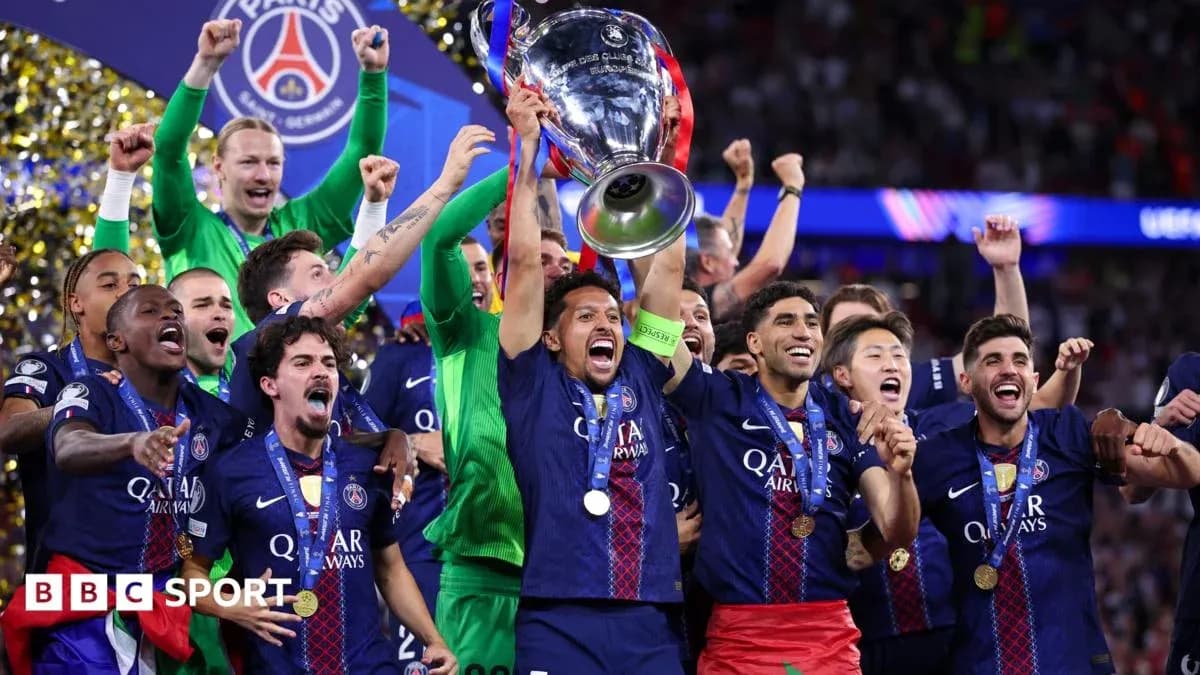
Paris St-Germain are chasing history. Two-time defending champions, Luis Enrique’s side are aiming for a three-peat that would redraw the modern map of European football. The odds, though, are brutal.
“Three in a row is impossible unless you’ve got Cristiano Ronaldo in your team, which they don’t.”
Julien Laurens doesn’t dance around it. Two straight titles already put PSG in rare air. A third would be something else entirely.
The league phase starts on Tuesday. The chase starts now.
PSG’s heavy crown
PSG have stumbled into the new season, their form jagged rather than smooth. Luis Enrique is still pushing them to the edge of what’s possible: high tempo, constant movement, suffocating pressure. It’s thrilling when it clicks, draining when it doesn’t.
Guillem Balague sees a team using the early months as a laboratory.
With the new league phase a long runway, PSG can absorb strange scorelines and tactical experiments before the real cut-and-thrust from January. The structure is there, the core is there, and Balague expects them to go “very close” again.
Laurens is more cautious. He still has them in the last four, but not on the podium’s top step this time.
Arsenal and Bayern lead the chase
If PSG loosen their grip, who rips the trophy from their hands?
For Laurens, the answer is Arsenal. Last season’s runners-up have hardened. The romance of their return has been replaced by something colder, more ruthless.
“They have the best defence in Europe by far and that's what wins you titles,”
he argues. In his bracket, Arsenal beat Bayern Munich in the final, with PSG falling in the semis and Bayern just missing out again.
Balague is just as convinced by Arsenal’s trajectory. The key, in his eyes, is psychological. They’ve learned how to win regularly; the tension has eased. Shoulders are looser. The football flows.
Bayern remain in the mix for both analysts. A machine that rarely drops below a certain level, powered now by a centre-forward with a Ballon d’Or in his sights.
Real Madrid, under Jose Mourinho, don’t quite convince Laurens as potential champions, yet their name still lurks in every conversation. Balague throws Manchester City into the cluster of heavyweights as well. The draw, as always, will be ruthless.
Barcelona, though, are the team Balague can’t ignore.
Barcelona rising under Flick
“Barcelona are flying.” It’s not a throwaway line. Under Hansi Flick, they have snapped back into something sharper, more vertical, more aggressive.
Flick still wants two more pieces – a centre-back and a number nine – to push them to what he considers the next level, but he already feels they are on the climb. He demands a high, passionate press, a structure that gives his brightest talents the stage they crave.
Balague sees Barca, PSG and Arsenal as three semi-finalists in waiting, if the draw doesn’t crash them into each other early. The fourth slot? Bayern, Real Madrid or Manchester City. No outsiders. No fairy tales. Not at this stage.
Five players who can bend the tournament
Laurens has his own shortlist of players who could tilt the competition.
At Real Madrid, Jude Bellingham steps into a defining season. Mourinho plans to use him as a number 10, the role that lets him time his runs, arrive in the box, and dictate the emotional tempo of games. After a strong World Cup, Laurens expects the momentum to carry: goals, influence, leadership.
In Como, a very different story is unfolding. Their first Champions League campaign, Cesc Fabregas on the touchline, and at the heart of it all, Nico Paz. The number 10 is the team’s compass with the ball, a playmaker still being sculpted, but already central to everything they do. Laurens is convinced he’s on a fast track to the top.
Then there is “Mr Champions League” himself: Khvicha Kvaratskhelia. Two sensational seasons at PSG have turned him into a continental obsession. On that left flank he is unpredictable, a winger who can go inside or out, lethal with either foot, technically audacious. He scores spectacular goals and drags people to the edge of their seats. Laurens has him in the Ballon d’Or conversation already.
In France, Lens return to the Champions League after pushing PSG to the wire in Ligue 1. At the back, 21-year-old Ismaelo Ganiou has emerged as their outstanding talent – quick, powerful, composed on the ball. Laurens expects this to be his last season before a Premier League heavyweight comes calling.
And in Italy, Donyell Malen has reinvented himself. Since leaving Aston Villa for Roma, he has been prolific, close to a goal a game as a lone striker in Gian Piero Gasperini’s high-octane system. Roma’s return to the Champions League brings their chaos and entertainment back to the big stage, and Laurens believes Malen is now back at his best level.
Kane’s mission and Yamal’s stage
Balague’s list has a different flavour.
At Bayern, Harry Kane is on a clear mission: win the Ballon d’Or. The numbers are there, the platform is perfect. Bayern’s style flatters his movement and finishing, and Balague sees no reason for his level to dip.
At Barcelona, Lamine Yamal is hungry. Still a teenager, he has already outgrown the “prospect” label. Flick’s high defensive line and aggressive structure create exactly the kind of broken-field situations where Yamal can devastate opponents. He wants the Champions League, not just minutes in it.
Kvaratskhelia appears again on Balague’s list, with the same theme: there is still another level to reach. With PSG expected to go deep, Balague sees him as the man who will keep rescuing them in tight moments, winning big games almost by force of will. In his eyes, a future Ballon d’Or winner is inevitable.
Shakhtar’s conveyor belt of Brazilian talent continues with Kaua Elias. At 20, he fits the club’s familiar model: raw, gifted, and already being measured in future transfer fees.
At Arsenal, Martin Odegaard looks ready to reclaim the narrative. After an injury-hit season, he has started this campaign sharply. Balague sees a player capable of dominating games again, in a team that now trusts itself at this level. Arsenal will need his authority in the biggest nights; he looks ready to provide it.
Fabregas’ Como and the new faces
Beyond the giants, the Champions League’s new structure gives room for fresh stories.
Balague is fascinated by what Fabregas is building at Como. The Spaniard turned down offers to leave, choosing instead to keep developing a project where, as Balague puts it, he can get things wrong without the sky falling in. That freedom has let him push bold ideas, and now he is not just catching up with modern football – he is on the front carriage. Balague backs Como to reach the knock-out stages in their debut campaign.
LASK, who knocked out Celtic, have already shown a hard edge. For Balague, a home win and a respectable points tally would be a strong return in their first Champions League season, even if progression looks unlikely.
Sabah, from Azerbaijan, arrive with organisation as their calling card but a brutal schedule: trips to Arsenal and Manchester United, home games against Barcelona and Borussia Dortmund. Balague expects them to bloody a nose or two, but not enough to escape the pack.
Then there is Viking. Drawn against Bayern, Atletico, Napoli and Aston Villa, they look outgunned on paper. Norwegian football, though, is full of sharp coaches and competitive teams, and Balague senses they could yet sneak into the knock-out rounds.
Five English clubs are in the field, Arsenal leading the bookmakers’ odds. PSG chase immortality. Barcelona and Bayern smell opportunity. Real Madrid and Manchester City lurk, as they always do, just behind the spotlight.
On 5 June in Madrid, only one of them will be right.