Caleb Wilson: The New Hope for the Chicago Bulls
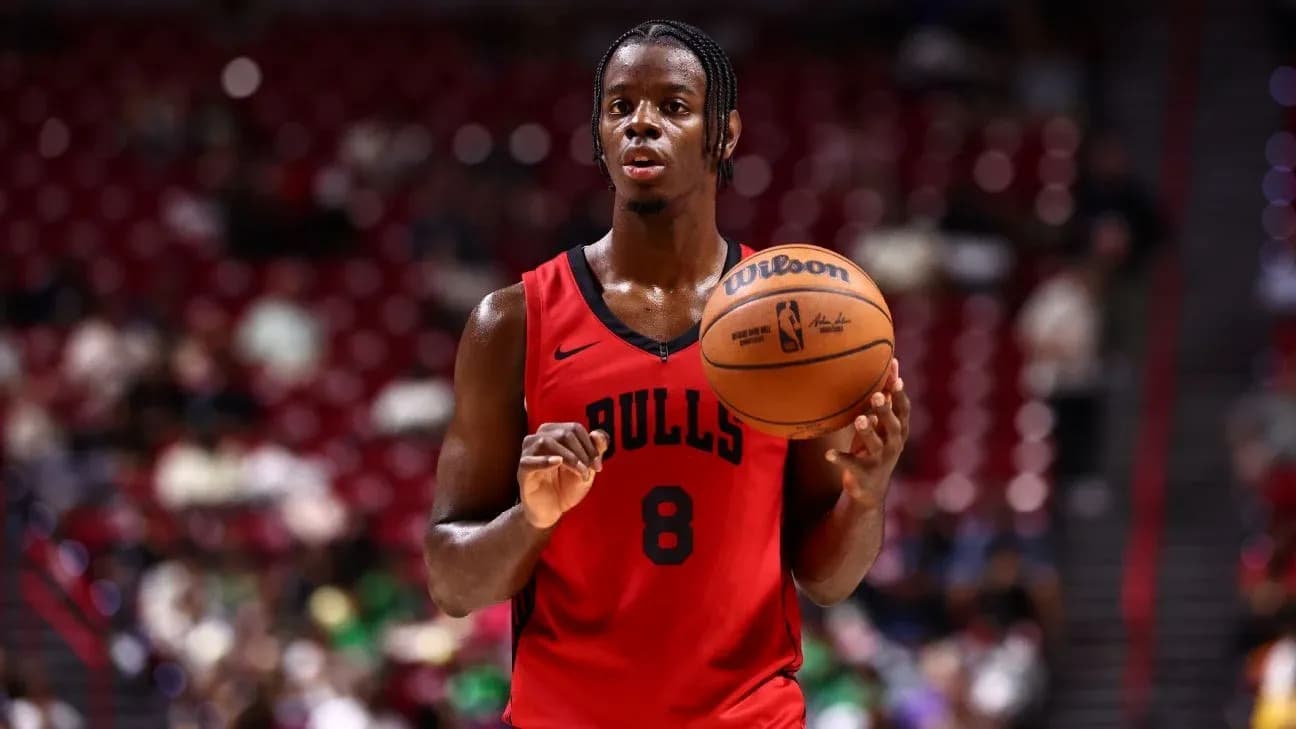
On an August afternoon outside the United Center, the past and the future of the Chicago Bulls stand almost shoulder to shoulder.
Fans swarm the atrium, snaking around barricades for a chance at a photo, an autograph, a moment. Inside, the line for Caleb Wilson’s meet-and-greet spills into the concourse. Outside, the Michael Jordan statue rises over it all, a bronze reminder of what this franchise once was.
In between those two images, the Bulls are trying to build what comes next.
Wilson, 20 years old and barely two months into his pro life, steps in front of a camera, screams, sticks out his tongue and plays to the crowd. Moments later, he’s headed to the parking lot to judge a slam dunk contest. This is Bulls Fest, a two-day celebration of the team. This is also something more: Chicago’s formal introduction to the player they hope will drag the franchise out of a decade of drift.
The Bulls took Wilson No. 4 overall in June, betting that the North Carolina forward can become the new face of a team that has missed the playoffs in eight of the past nine seasons. They are not shy about what they need from him. A jolt. An identity. A reason for the United Center to feel important again.
The hype arrived early, then exploded in Las Vegas.
A summer league star is born
Wilson’s first professional game in the NBA’s summer league wasn’t just good. It was historic.
He poured in 35 points, the second-highest scoring rookie debut in summer league history, and buried seven 3-pointers. For a player whose college scouting report came stamped with “shooting concerns,” it was a loud, almost defiant opening statement.
Game two brought the clip that ricocheted around social media. Wilson took off and soared over 6-foot-11 Jonas Aidoo, the Utah Jazz center, for a thunderous dunk that instantly joined the short list of the summer’s best highlights.
By game four, the buzz around the 6-foot-10, 215-pound rookie had drawn Hall of Famer Kevin Garnett to courtside. Garnett watched the wiry forward move, slash, rise, and the comparisons that had been whispered for weeks suddenly felt less outrageous. Both long. Both elastic. Both built to play above the rim and all over the floor.
Draymond Green, on his podcast, had already pushed the conversation into rare air.
“I actually think his floor is Kevin Garnett,” Green said. “And man, if that’s your floor, oh my god. Do you know how great KG was? I actually think with Caleb Wilson, Kevin Garnett could be his floor. That’s how special I think Caleb Wilson is.”
NBA teams usually roll their eyes at summer league overreactions. Wilson made that difficult.
“He looks,” one Bulls source told ESPN, “like we got a dude.”
Over four games, Wilson averaged 23.5 points, 7.3 rebounds, 1.3 steals and 2.5 blocks, earning a spot on the all-summer league first team. When staffers told him his 35-point debut ranked among the highest in the event’s history, he shrugged. Chicago had lost. That was what stuck with him.
He had cried before that first tipoff, five months to the day since an injury ended his college season. Not out of nerves, he said, but because he had waited so long to get back on the floor.
While other top picks shut it down after two or three games, Wilson pushed to keep playing. He texted Bryson Graham, the Bulls’ new head of basketball operations, lobbying to suit up on the second night of a back-to-back.
The Bulls didn’t need much convincing.
Rebuilding the Bulls, one cornerstone at a time
Wilson is not arriving alone. He’s the most visible piece of a near-complete reset.
Ownership hired Graham to run basketball operations, leaning into his reputation for draft work and talent identification. Graham’s first major move was to bring in Tiago Splitter as head coach, a former NBA big man whose coaching résumé is dotted with development success stories.
Splitter helped Deni Avdija blossom into an All-Star in Portland. As an assistant in Brooklyn, he worked closely with Jarrett Allen. In Houston, he helped shepherd a young Alperen Sengun. Now, Chicago is his first full-scale project.
“The first thing you do is connect,” Splitter said. “That’s the foundation of everything you do, especially at this level. If you don’t have that, it’s really hard to demand and make them respect you.”
Splitter started that process with Wilson almost immediately. They bonded over music. The rookie, who picked up the guitar this summer, jumped from hip-hop to classical to country without blinking. The coach took note.
“Very interesting young guy,” Splitter said. “You see how his brain functions and the variety of things he can have a conversation about.”
On the court in Las Vegas, Splitter coached the Bulls’ first two games, using the setting to lay down the basics of his culture. He handed Wilson primary ballhandling duties, turning the rookie into a point forward and asking him to orchestrate. It’s a twist Garnett never had in his Hall of Fame career, and a glimpse of how Chicago might eventually weaponize Wilson’s versatility.
Those responsibilities will ease once the real season starts. Josh Giddey, Norman Powell and third-year forward Matas Buzelis — who started 77 games last season — will share the creation load. Wilson won’t have to do everything. The Bulls don’t want him to.
Graham filled out the roster with veterans such as Powell and Nic Claxton, not to chase an immediate playoff berth, but to build a functioning environment around their young core.
“It builds a healthy environment,” Graham said. “It gives the younger guys confidence, too, because they know that, when it is going bad, they have some guys that have done it, some guys that have won and had success and they can learn.”
Inside the organization, the message is consistent: growth over shortcuts. After years of trying to fast-track their way back into relevance, the Bulls are finally preaching patience.
There is no mandate to make the play-in. No edict to crash the Eastern Conference playoff picture in Year 1 of the Wilson era.
Wilson’s own bar, though, is set higher.
“I expect to have Rookie of the Year, honestly,” he said. “I’m going to work hard. I’m going to do what it takes. I feel like the team is really good for me and how I envision to play.”
Fixing the flaw that almost cost him Chicago
The irony of Wilson’s Las Vegas shooting display is hard to miss.
His seven made 3s in his summer league debut were more than he hit in his entire freshman season at North Carolina. Concerns about his jumper, along with the injury that cut short his year and kept him out of the NCAA tournament, were the biggest knocks on his draft résumé. They helped push him behind AJ Dybantsa, Darryn Peterson and Cameron Boozer in the 2026 class.
Wilson pushed back on the narrative. He pointed to North Carolina’s system, which didn’t ask him to space the floor from deep; he averaged just 1.1 attempts from 3 per game. The moment his college season ended, he went to work on the shot everyone questioned.
“I’m glad I didn’t shoot 3s in college,” Wilson said this summer. “Because if I did, I wouldn’t be here. I don’t know where I’d be. I don’t think I’d be a Bull.”
A broken thumb and a fracture in his left wrist ended his season in February. The cast kept his thumb locked straight; he couldn’t move it. But he could still grip a ball. He could still rehearse his form. So he did, over and over.
Since then, Wilson estimates he has been putting up between 2,000 and 2,500 3-pointers a day.
Inside the Advocate Center, that number has become part of the Wilson lore. His summer league numbers turned heads around the league. His daily routine impressed the people who see him most.
He has barely left Chicago since the draft. Mornings at the practice facility. Back home. Then back again around 8 or 9 p.m. for another session, often alongside fellow first-round pick Dailyn Swain, taken No. 15 in June. Workouts often run toward midnight.
“Everybody highlights his athleticism, which is generational,” Swain said. “But he can do a lot of things. He’s really good facing up at the elbow, jab. He has a really good midrange shot. He’s been knocking down 3s, so he’s widening his arsenal.”
The Bulls are betting that this is who Wilson is: the worker who cried before his debut, the kid who texts the front office asking to play one more game, the prospect who turned his biggest weakness into a daily obsession.
A serious coach, a flexible plan
Splitter arrives in Chicago with a reputation for adaptability.
In France, he pushed Paris Basketball into the EuroLeague playoffs with a fast-paced, free-flowing offense. Last season in Portland, when he took over as interim coach, the Trail Blazers carved out a surprise run to the No. 7 seed in the West by leaning on defense.
“You have to adapt your system to the players you have,” Splitter said. “Yes, I have a vision. I have a certain way I want to play, but you also have to explore what they do best. That’s what we’re going to do here.”
Wilson already has a clear view of the man now guiding his career.
“He’s really detailed,” Wilson said. “He knows what he wants you to do and he’s pretty serious. Most coaches, you have coaches that are joking around and stuff like that. Tiago’s pretty serious and he knows what he wants.
“I’d rather have someone who’s serious and straightforward with me, so I know what I can do better.”
This is Splitter’s first chance to shape a roster almost from scratch, to build a style that fits a young, long, athletic group headlined by a 6-foot-10 rookie who can handle, finish and, if his summer is any indication, stretch the floor.
It’s also his first crack at a city that has been starved for a winner and is now clinging to a new hope.
The work before the noise
As has become tradition, Bulls players gathered in Miami last week for a player-run minicamp, a prelude to training camp and a quiet test of chemistry.
No cameras. No fan fest. Just a group trying to figure out what it can become.
Back in Chicago, the statue of Jordan still draws tourists, still commands the selfie angles, still towers over Bulls Fest. That will never change. The franchise’s history is too big, too loud, too gilded.
What the Bulls are asking Caleb Wilson to do is not to replace that history, but to give it a worthy sequel.
He sounds ready for the responsibility, or at least unafraid of it.
“I do expect to win,” he said. “Whatever it takes to win is what I’m going to do.”
For a team that has spent nearly a decade searching for a way forward, that is exactly the kind of promise they’ve been waiting to hear. Now they’ll find out how quickly he can turn it into something real.