Bayern Munich Overcomes Early Setback to Win 4-1 Against Osnabrück
Bayern Munich needed less than five minutes in Osnabrück to be reminded that the DFB-Pokal does not respect reputation.
By the time Robin Meißner’s strike crashed into the net, the Bundesliga champions were a goal down, their backline scattered, and the home crowd roaring as if a cup upset was already brewing.
They woke up quickly.
A chaotic start, a ruthless response
Thomas Tuchel did not treat this as a routine early-round tie. The lineup was strong. Kim Min-jae preferred to Dayot Upamecano. Josip Stanišić in at right-back. Nathaniel Brown given another look over Alphonso Davies on the left. Tom Bischof rewarded with a start ahead of Aleksandar Pavlović.
The message to VfL Osnabrück was clear: Bayern came to finish the job early.
Instead, the opening act belonged to the underdogs. Jonathan Tah and Kim lost their bearings on a hopeful attack, Tah slipped, Jonas Urbig strayed too aggressively, and Meißner pounced with a stunning long-range hit in the 5th minute. One lapse, one rocket, 1-0.
For a brief spell, Bayern looked rattled. The crowd sensed it. The noise climbed, the tackles flew in, and Osnabrück fed off every duel won.
But the gulf in quality eventually told.
Bayern pinned the hosts back and began to dictate. Ismael Saibari, eager but disjointed, struggled to find his rhythm, flashing ideas without the final touch. Brown stayed conservative on the left, solid defensively but rarely venturing with real menace. The champions probed, recycled, and pushed the tempo, yet Osnabrück’s compact shape made every opening feel hard-earned.
The breakthrough came the ugly way — and that suited Bayern just fine.
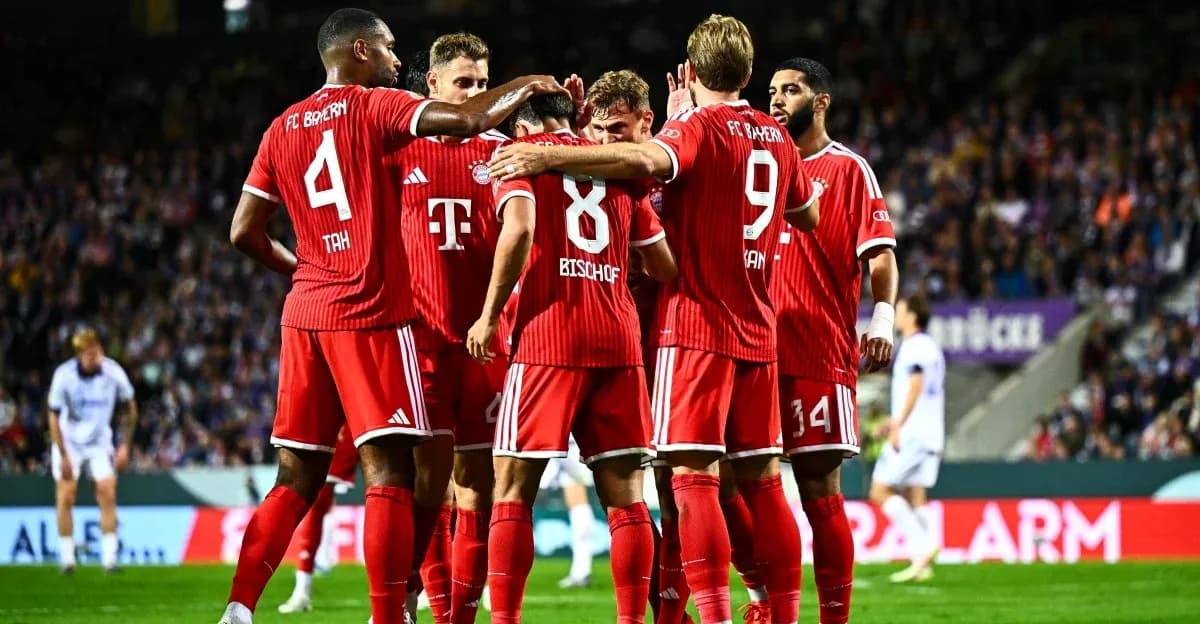
In the 18th minute, Joshua Kimmich floated a ball toward Harry Kane making a straight run. The defender’s attempted clearance went nowhere, looping straight up. Kane didn’t hesitate. He met the dropping ball with a thumping volley, burying it to level at 1-1. One mistake, one elite finisher, and the tie reset.
The pressure finally broke Osnabrück again just five minutes later. Michael Olise, drifting into pockets between the lines, slipped a superb pass into Luis Díaz. His effort was saved by Jonas Krumrey, but Bischof had read the moment perfectly, arriving to sweep home the rebound for 2-1.
From there, Bischof turned the game into his stage. Relentless pressing, constant movement, clever positioning — the young midfielder never stopped running, never stopped offering himself. Osnabrück simply could not shake him off.
Fault lines at the back, questions on the left
Not everything in Bayern’s performance will comfort Tuchel.
Tah and Kim, on paper a formidable pairing, looked anything but cohesive. Their timing was off, communication uncertain, and the early goal underlined just how fragile the partnership currently is. Tah in particular looked rusty, his lateral movement labored and his reactions a half-beat slow. It is far too early to panic, but this is not yet a pairing that inspires calm.
On the flanks, Brown’s audition at left-back continues to intrigue. He defended with discipline, rarely caught out, but the game passed him by in an attacking sense. The patterns of play did not naturally funnel the ball to his side, and he never quite imposed himself going forward. When Davies replaced him in the 62nd minute, the dynamic did not dramatically shift either.
For now, the battle between Brown and Davies is open rather than electric. Neither man seized this particular evening as a defining moment.
Osnabrück, for their part, refused to fold. They chased, pressed, and hacked away at Bayern’s rhythm, with Krumrey producing a standout save to deny Olise just before the break and keep the tie at least within reach.
They were outgunned, not outworked.
Olise takes control, Kane finishes the job
The second half sagged.
Bayern, with an English Week already tugging at their legs, dipped in intensity. The tempo dropped, the passes slowed, and the crowd’s early fury mellowed into a more subdued hum. Brown and Saibari departed for Davies and Lennart Karl just past the hour, but the pattern hardly changed.
Olise changed it himself.
Shifted centrally into the No. 10 role once Saibari exited, the Frenchman began to orchestrate. In the 73rd minute, he capped his growing influence with a composed finish for 3-1. The control of the ball involved a touch with his elbow that would almost certainly have drawn VAR intervention in a league match, but in this Pokal tie it stood. With that, any lingering tension evaporated.
From then on, Bayern played the game they wanted, not the one Osnabrück demanded. The urgency drained away, replaced by a kind of professional autopilot. It was functional, not thrilling.
There was still time for Kane to add his signature to the scoreline once more. In the 84th minute, Pavlović was brought down in the box, and the referee pointed to the spot. Kane stepped up with his usual poise and rolled in the penalty for his second of the night and Bayern’s fourth. No fuss, no drama, 4-1.
The final minutes drifted. No late surge from Osnabrück, no extra flourish from Bayern. The job was done long before the whistle.
Work in progress, result secured
This will not be remembered as a classic Bayern cup performance. The second half dragged, the defending wobbled, and the attacking fluency came in bursts rather than waves.
But the season is only just stretching its legs. A team still learning each other’s movements, still bedding in new partnerships, still sorting out key positions, walked into a fired-up lower-division stadium, fell behind early, and still walked out 4-1 winners.
For now, that is enough.
The Pokal campaign moves on. The next checkpoint comes quickly: a weekend meeting with Schalke 04, and another chance for Bayern to turn a workmanlike start into something sharper, slicker, and far more like the machine they expect to become.