Barcelona’s Armband Debate: Leadership Beyond Tradition
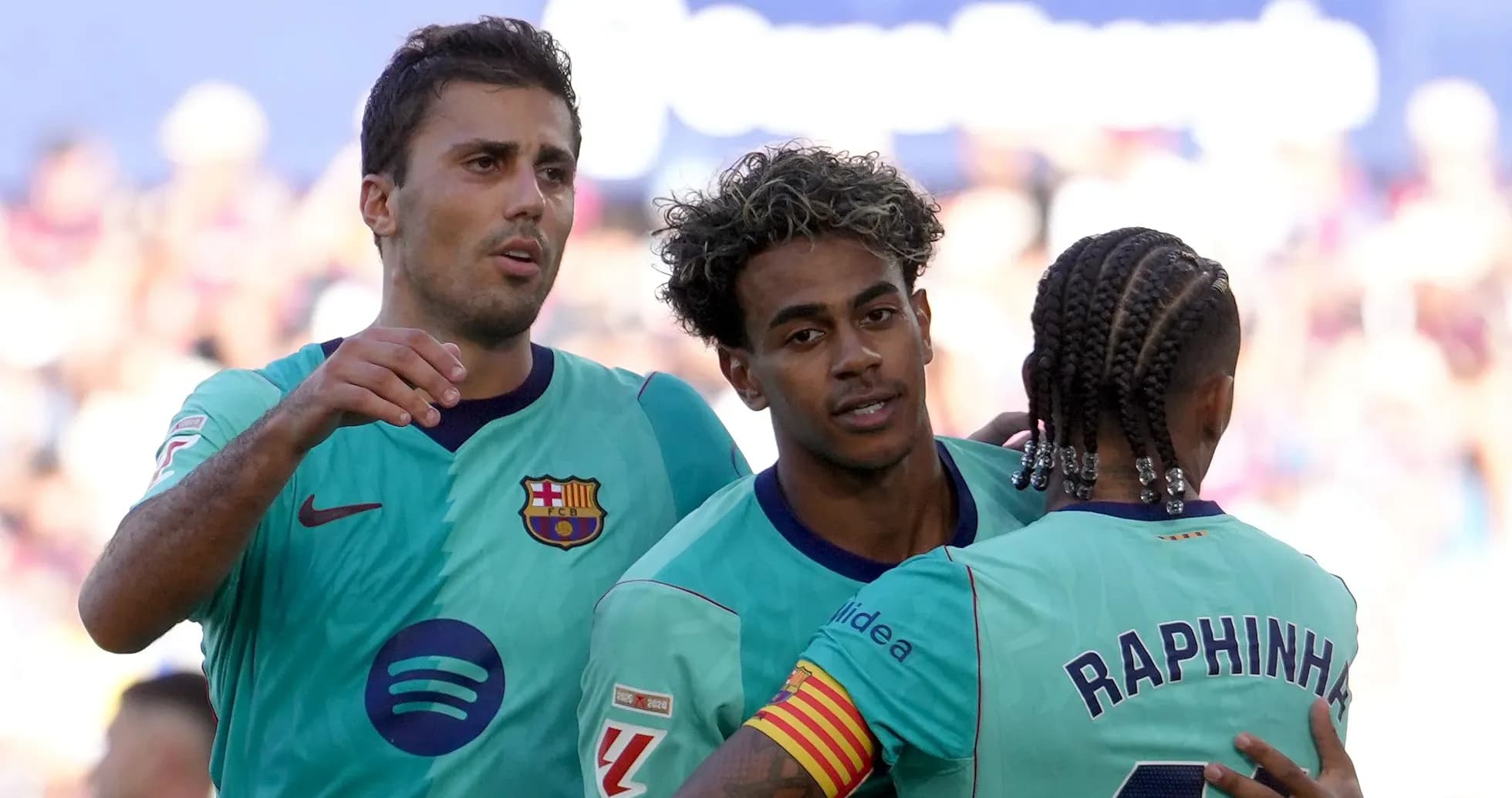
Barcelona’s armband debate has always been about more than fabric. It is about hierarchy, history, and who truly owns the dressing room. This season, Hansi Flick has made it clear he is willing to bend tradition—just not break it completely.
Flick’s Bold Call, Dressing Room’s Final Word
Barcelona confirmed their five captains for the 2026-27 season with a twist. Flick did not wait for the usual slow-burning, internal evolution. He stepped in.
Raphinha and Pedri were directly appointed by the German coach as the primary leaders, a clear statement about who he trusts to front this new era. Behind them, the squad had its say. Eric Garcia, Frenkie de Jong, and Lamine Yamal completed the leadership group after a dressing-room vote.
Yamal’s inclusion, at just 19, jolted the conversation. Not because he lacks talent or personality—he has both in abundance—but because of the name missing from the list.
Rodri.
The €76.5m signing from Manchester City arrived with a World Cup winner’s medal and the aura of Spain’s captain. On paper, he looks like the archetypal leader. On the ballot, he never stood a chance.
Seniority Over Stardom
According to The Athletic, Barcelona’s internal vote leans heavily on club seniority. Not on what a player has done elsewhere. Not on how many trophies he has lifted in other colours.
By that metric, Yamal is no surprise. He may be 19, but he has already lived three seasons inside the first-team environment at Camp Nou. Rodri only walked through the doors in mid-August.
This is how Barça works. The armband is not a reward for a glittering CV; it is a symbol of roots. Of time served. Of shared scars and shared nights.
Rodri does not have that history yet. What he does have is something Flick has already decided he cannot do without.
Rodri’s Presence Without the Armband
Rodri’s first start, against Valencia, underlined why Barcelona moved so aggressively to bring him in. Flick did not need long to voice his appreciation.
“We’re pleased to have Rodri in our team,” the coach told reporters after that match. “You can also see everything he does with the ball, everything he does on the pitch. It makes sense. He gives the team structure in attack with the ball, but also without it.”
Structure. Order. Authority. These are captain’s qualities, even if the title belongs to someone else.
Rodri’s influence has not been confined to the pitch. During the 5-0 win over Valencia, television cameras caught him on the bench, leaning into Pau Cubarsi and delivering a blunt assessment: “They’re really weak, they haven’t got past the halfway line.”
It was the kind of unfiltered, competitive edge that lives in every elite dressing room. The problem was that this one went public.
A Veteran’s Response
The moment Rodri realised his words had been broadcast, his reaction said more about his leadership than the original comment.
He picked up the phone himself. Valencia captain Jose Gaya received a personal call of apology. Rodri then addressed the incident publicly after Barcelona’s Champions League win over Feyenoord, taking ownership in front of the cameras.
No armband. No obligation. Just a senior player understanding the weight of his voice.
Inside the club, that has not gone unnoticed. Rodri may not appear on the official captain’s list, but he is already being treated as one of the key pillars of this young squad.
Mentoring the Next Anchor
Barcelona see Rodri as more than a short-term fix at the base of midfield. Behind him, Marc Bernal, a 19-year-old defensive midfielder, is being quietly ushered into the spotlight.
Club insiders already talk about Rodri as a crucial mentor for Bernal. The two have begun to share minutes, with Bernal coming on to partner the former City man in recent wins over Feyenoord and Levante.
For a teenager, there are few better guides than a World Cup-winning pivot who has seen every type of game, every type of pressure. Bernal is learning in real time what it means to control the tempo, to read danger, to carry responsibility.
The armband might sit on someone else’s arm. The standard in that position is being set by Rodri.
Tradition vs Reality
At Barcelona, the captaincy has always been tied to institutional memory. From Carles Puyol to Lionel Messi and beyond, the role has carried a sense of continuity. The dressing room vote reflects that: it rewards those who have grown up inside the club’s walls, or at least lived within them long enough to be considered part of the furniture.
Rodri, for all his pedigree, is still new furniture.
Yet his presence already cuts through the noise. He talks. He organises. He apologises when he needs to. He guides the next generation. The squad may not have placed an armband on him, but they have clearly handed him responsibility.
A Brutal Run, A Crucial Voice
Barcelona will need that voice soon enough. The calendar offers no soft landing.
Over a 12-day stretch next month, Flick’s team must go away to Galatasaray, Real Betis, and Paris Saint-Germain. Hostile atmospheres, high stakes, little room for error. That sequence then funnels into a defining night: El Clasico against Real Madrid at Camp Nou on October 25.
For Rodri, that game carries an extra charge. He turned down strong interest from Jose Mourinho’s Madrid to join Barcelona this summer. He chose the other side of the divide, knowing exactly what that meant.
By then, the debate about who wears the armband may feel secondary. The real question will be this: when the pressure peaks in that brutal run, whose voice cuts through the chaos in the middle of the pitch?
All signs point to the same answer—whether the captain’s list says so or not.