Australian Football Referees Strike: A Crisis Ahead of A-League Kick-Off
Australian football rarely enjoys a quiet off-season. It prefers turbulence.
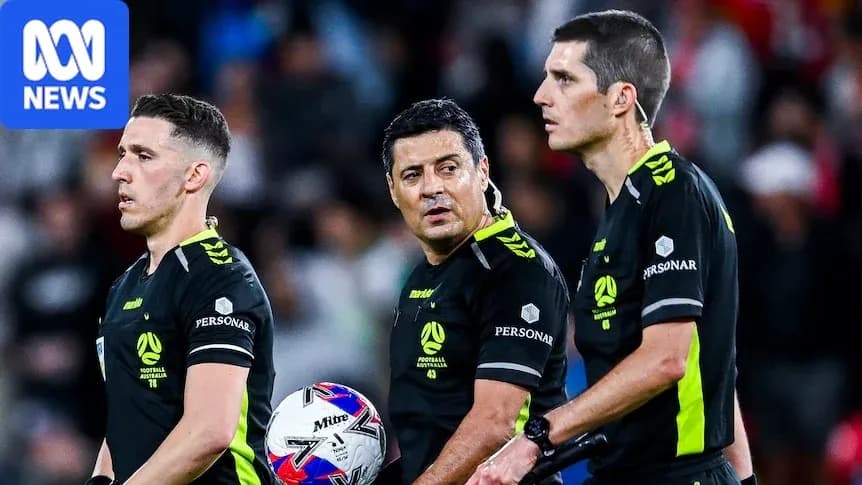
With the A-League Men and Women less than a month from kick-off, the sport has stumbled into yet another crisis – this time with the people who blow the whistle walking off the job.
Since September 4, the country’s elite referees have been on strike, protesting what they describe as “significant changes to the elite refereeing structure” put forward by Football Australia (FA). The proposed shift would see match officials contracted directly by the Australian Professional Leagues (APL), rather than by FA.
To the Professional Football Referees Association (PFRA), that’s not a mere administrative tweak. It’s a red line.
The union has warned the changes would be “detrimental to individual referees and represent a drastic step backwards for the professional refereeing program”. Talks drag on. The new A-League seasons loom. And the two sides are stuck.
Both the APL and FA insist they are still working together to find a way through. The PFRA, in a statement earlier this month, said it would “continue to engage with Football Australia with the aim of resolving the outstanding matters and returning its members to the field as soon as an acceptable outcome can be reached”.
Everyone in the game knows the obvious truth: without referees, there is no competition. So how did Australian football end up here again?
A split that never really settled
To understand the current standoff, you have to wind back to 2020 and the so-called “unbundling” of the A-Leagues from Football Australia.
After years of pressure from clubs and from FIFA over governance, FA handed over full control of the professional leagues to a new body, the APL. The idea was simple enough: let the clubs run the commercial side of the competition, as happens in the Premier League, Bundesliga, J-League and elsewhere.
The clubs believed independence would unlock growth and secure the league’s long-term health.
The reality has been far harsher.
In 2024, half of A-League Men players said they were “dissatisfied” with how the competition had been run by the APL, and close to half reported “low trust” that the league would improve. The numbers painted a bleak picture of confidence in the game’s leadership.
Money told the same story. This year, the APL slashed its annual distribution to clubs from close to $2 million to just $530,000, a cut driven by a deteriorating financial outlook. That came on the back of the widely condemned decision to sell grand finals to Sydney, a move that alienated supporters and coincided with falling attendances and interest.
Since then, stalled expansion plans, the exit of Western United from the competition, and the recent breakdown in collective bargaining talks with players have deepened the sense of mistrust around the league.
Into that fragile environment walked the referees’ dispute.
Who pays – and who they answer to
Since the unbundling, FA has still been responsible for supplying referees to A-League matches, with the APL reimbursing those costs. It was an uneasy but workable compromise.
Now FA has drawn a line. The governing body has proposed it will only fund officials for matches under its own jurisdiction – the Australia Cup and the second-tier Australian Championship. Anything involving the A-Leagues, FA argues, should be paid for directly by the APL under the terms of their agreement.
On the surface, that sounds like a contractual tidying-up exercise. For the PFRA, it cuts to the heart of integrity.
If referees are contracted directly by the league they officiate, they argue, they are effectively employed by the same clubs whose fortunes they control on the pitch. That, in their view, is a conflict of interest that undermines the very thing a referee must protect: impartiality.
“Such an arrangement would place referees in an unacceptable position of potential conflict and raise serious concerns regarding the integrity and impartiality of the refereeing program,” the PFRA said.
The union wants an independent refereeing body, similar to England’s Pro Ref (formerly PGMOL), that sits at arm’s length from both the league and the clubs. It has described the proposed structure as “untenable”, insisting referees “cannot grow without trust [or] succeed without independence”.
FA rejects the integrity concerns and maintains its proposal complies with FIFA regulations.
Tensions have been inflamed further by a dispute over money already earned. The PFRA claims match officials who worked in trial games involving A-League clubs have not been paid outstanding fees by FA. FA flatly denies it owes anything.
So the referees have stepped away, and the scramble to keep matches going has begun.
Patchwork solutions, rising stakes
The impact has already been felt.
For the Australia Cup semifinal between Sydney FC and Melbourne Victory on September 9, Football Australia had to fly in four referees from Singapore to ensure the tie could go ahead. In the second semifinal, between South Melbourne and Lions FC, young Australian official Rowan Fisher – who has no A-League experience – was handed the whistle.
FA insists there is no risk to the Australia Cup final between South Melbourne and Melbourne Victory on October 10. A separate group of referees has signed contracts with FA and remains available for its competitions. The second season of the Australian Championship, due to start on Thursday October 15, is also expected to proceed as planned.
Those tournaments sit safely under FA’s umbrella.
The A-Leagues do not.
With the men’s and women’s seasons due to begin the same weekend as the Cup final, there are still no guarantees that elite officials will be in place. No clear Plan B has been announced, no firm assurances offered.
For a competition already battling to win back fans and credibility, the prospect of starting a new season under a cloud of makeshift officiating or last-minute deals is alarming.
Referees who want to work – but on their terms
The country’s leading referees insist they do not want to be on strike. They want to be fit, ready and back in the middle.
But they also want their profession treated with respect and given a structure they can trust.
“Our members have delivered an overwhelmingly clear message. They are seeking certainty around their employment, payment of outstanding amounts, and a clear and sustainable structure for professional refereeing in Australia,” PFRA president Evgeny Vizelman said.
“We do not take the decision to stop officiating matches lightly. Our members want to officiate football, prepare for the upcoming season and positively contribute to the success of football in Australia.
“Nobody becomes a referee because they want to withdraw their services.
“Taking ourselves off the field hurts. There comes a point where people have to stand together and say the way they are being treated is not good enough.”
The clock is ticking towards opening weekend. The players are ready, the fans are waiting, the league is desperate for a clean start.
Whether the people in the middle are there to blow the first whistle of the new season will say plenty about where Australian football is really heading.