Atlantic Division Overview: A New Era in the NBA
The Atlantic Division doesn’t just look different. It feels different.
One blockbuster swap between Boston and Philadelphia detonated the old hierarchy, and then LeBron James walked into the picture and blew up the rest of the assumptions. The defending champion New York Knicks are suddenly the hunted, not the hunters. The Sixers might have the league’s scariest starting five. Boston is bruised but stubborn. Brooklyn is stockpiling talent with intent. Toronto believes its core is ready to grow up fast.
Training camp hasn’t even opened, and the Atlantic already looks like the NBA’s main stage.
New York Knicks: From drought to standard-bearer
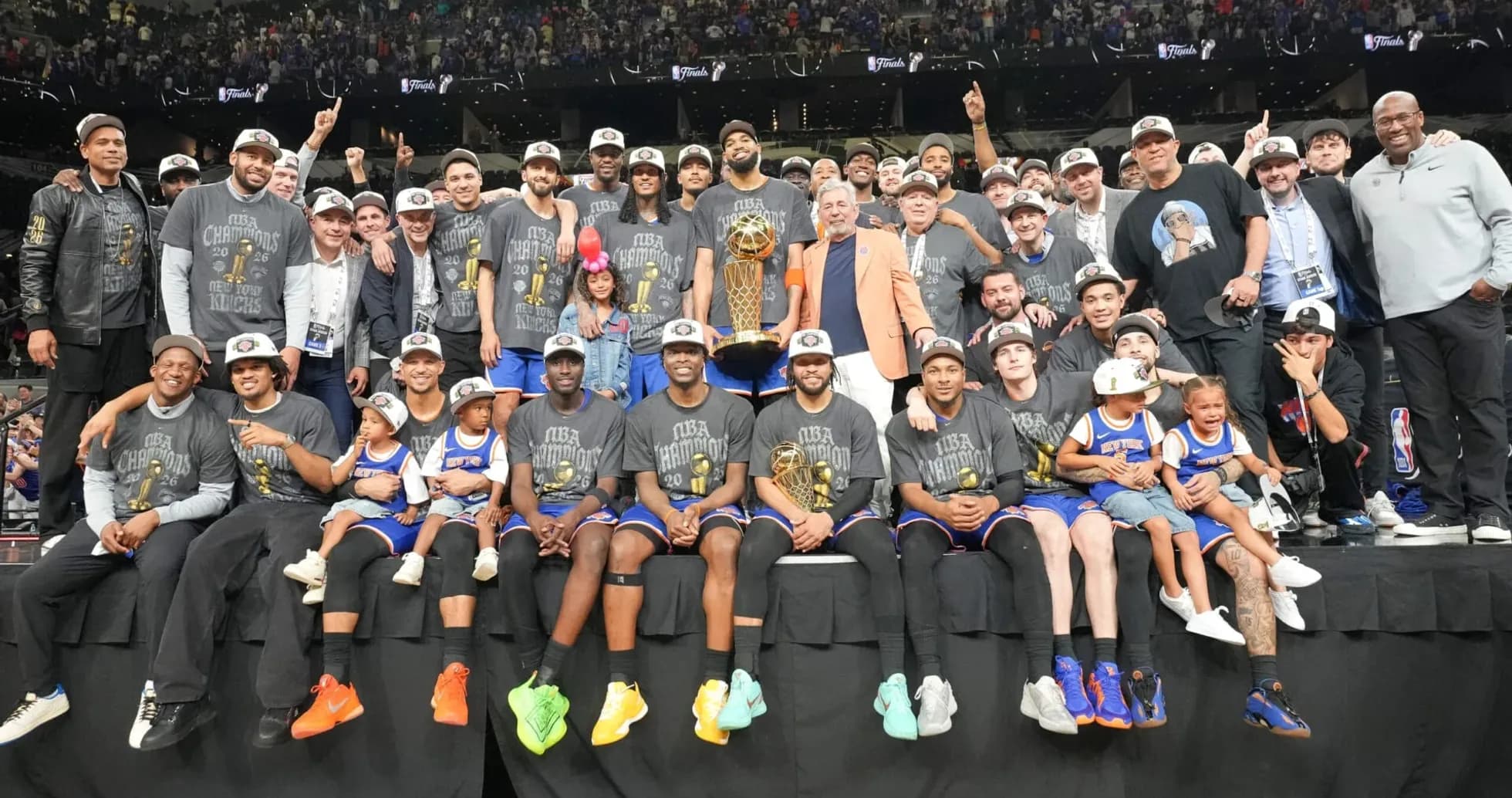
Fifty-three years without a parade in Manhattan. Then a 53-29 season, a title run, and Jalen Brunson lifting the Finals MVP trophy. The Knicks didn’t just win; they reset the emotional temperature of a franchise and a city.
They also earned something rare in New York: patience.
There’s no mandate to repeat. No ultimatum hanging over the locker room. Yet the roster still carries the look of a team that expects to stay in the fight.
Mitchell Robinson is gone, cashing in with Boston after anchoring the middle of that championship defense. That’s the one real dent in the rotation. The Knicks responded with a simple, veteran move: Andre Drummond arrives as insurance behind Karl-Anthony Towns, still one of the league’s most skilled offensive bigs and a matchup nightmare when he’s rolling.
Beyond that, Leon Rose and company barely touched a winning formula. Jack Kayil and Tyler Nickel are depth plays, not headline moves. The core remains intact: Towns stretching the floor, OG Anunoby smothering wings, Josh Hart doing all the connective, gritty work, and Brunson running the show as the late-game closer who just proved he can carry a franchise through June.
The Knicks don’t need to be louder. They just need to be themselves again. After five decades of waiting, the next banner in New York will be measured against months and years, not ghosts.
Boston Celtics: Tatum’s team, and a test of resilience
Boston rode an MVP-level season from Jaylen Brown to a 56-26 record while Jayson Tatum spent most of the year on the mend. Then the postseason arrived, and the Celtics stumbled out in the first round, their promise evaporating almost overnight.
Now Brown is in Philadelphia. The rivalry just got personal.
The Celtics’ answer was not to retreat but to retool. Mitchell Robinson comes in to patrol the paint, giving Boston a vertical, defensive presence it hasn’t truly had in years. Paul George joins the wing rotation, a bet that there’s still high-end two-way basketball in him if his body cooperates. Mike Conley arrives as the veteran guard who can steady an offense and a locker room, while Chris Cenac Jr. and Dillon Mitchell add size and athleticism to the forward group.
Strip away the names, and the story is clear: this is Tatum’s team now, without question. With Brown gone, the offensive hierarchy sharpens. Tatum will carry the burden, and Boston is banking on him to be the kind of every-night force who can drag a roster through the East.
If George rebounds, if Derrick White finds his best form again, if Robinson plugs the defensive leaks, the Celtics should be back in the postseason mix. They’ve lost star power but not identity. The question is whether that identity can still punch with the new superpower in their own division.
Brooklyn Nets: Building around Porter, betting on Randle
The Nets spent last season handing minutes to a young core and paid the expected price: 20-62, fifth in the division, and a lot of painful film to digest.
This summer, the approach shifted. The front office decided that Michael Porter Jr. needed help now, not in three years.
Enter Julius Randle.
The former All-NBA forward returns to familiar territory, back in New York with a different jersey and a fresh assignment: stabilize a young, fragile group and give it a legitimate offensive anchor next to Porter. Randle’s best years came just across the bridge with the Knicks; Brooklyn is counting on that version, or something close to it.
The draft remained central to the Nets’ plan, just in a more targeted way. Mikel Brown Jr., taken at No. 6, arrives from Louisville with true combo-guard skills and a clear runway to early minutes. On a roster in transition, he won’t have to wait long to test himself against starters. The Randle trade also delivered another first-round pick, used on Joshua Jefferson at No. 28, adding more size and versatility on the wing.
Keon Ellis and Moritz Wagner deepen the rotation, Tyler Bilodeau adds another forward option, and Nic Claxton and Ziaire Williams exit as part of the reshaping.
There’s urgency here. Brooklyn, a franchise that hoarded draft capital last year, doesn’t control its own first-round destiny next season; Houston holds swap rights. The Nets can’t afford another 20-win season. They don’t need to be great yet. They just need to be clearly, undeniably better.
Philadelphia 76ers: LeBron, Brown, Embiid – a superteam with scars
The Sixers have lived this story before: Joel Embiid plays at an MVP level, his body betrays him, and a promising season slams into the wall. Last year, they still managed 45 wins and a trip to the conference semifinals.
This year, the stakes are different. Because this year, LeBron James chose Philadelphia.
Even if the offseason had stopped with Jaylen Brown crossing the border from Boston, the Sixers would’ve been headline material. A former Celtic star joining a long-time rival, sliding into a core with Embiid and Tyrese Maxey, was enough to reset expectations.
LeBron’s decision pushed it into another tier.
Now, on paper, Philadelphia can roll out a starting five that belongs in any “best in the league” conversation: Embiid, a former MVP; LeBron, still one of the sharpest minds and most complete players in basketball; Brown, fresh off an MVP-caliber season; All-NBA guard Maxey; and All-Rookie guard VJ Edgecombe, the electric newcomer. Around them, the front office added Kentavious Caldwell-Pope for perimeter defense and spacing, Ariel Hukporti for depth at center, Labaron Philon Jr. as a developmental guard, Anfernee Simons as a scoring weapon, and Dean Wade as a stretch forward.
Paul George, Kelly Oubre Jr., Quentin Grimes, Andre Drummond, Dalen Terry, Trendon Watford, and Johni Broome exit, symbols of a previous era that never quite broke through.
The equation now is brutally simple. If LeBron’s age doesn’t catch up to him and Embiid’s body holds, the Sixers have the talent to chase their first title since 1983. If either falters, all that star power could turn into a spectacular what-if.
For now, they are the league’s must-watch experiment, with the weight of history sitting squarely on their shoulders.
Toronto Raptors: Quiet summer, loud potential
While the rest of the division roared, Toronto barely raised its voice.
The Raptors finished as the East’s No. 5 seed and pushed their first-round series to a Game 7. They responded to that near-miss with a restrained offseason: Kyle Anderson joins as a savvy, versatile forward; rookies Jaden Bradley and Allen Graves arrive; Sandro Mamukelashvili departs.
The message is obvious: the improvement needs to come from within.
Toronto can hurt you from anywhere on the floor. On many nights, three – sometimes four – players can get to 20 points, and there’s a solid group of defenders behind that scoring. It’s a balanced, modern attack that doesn’t lean on one savior.
The internal growth starts with Collin Murray-Boyles. He eased into his rookie year, then elevated his play in the postseason, flashing real post craft and a soft touch around the rim. Ja’Kobe Walter and Jamal Shead appear to be on a similar upward climb, guards who can both score and compete defensively.
All of it orbits around Scottie Barnes. He remains the franchise pillar, the do-it-all forward whose game keeps expanding. With RJ Barrett alongside him and a supporting cast that looks more confident by the month, the Raptors are positioned not just to return to the playoffs, but to demand a deeper run.
The Atlantic Division used to run through one or two teams. Now, every stop on the schedule feels like a test. Champions in New York. A superteam brewing in Philadelphia. A proud contender recalibrating in Boston. A restless project in Brooklyn. A rising, well-rounded group in Toronto.
Someone is going to get left behind. The only question is who blinks first.