Atlanta Hawks: A New Identity After Trae Young
The Hawks spent last spring pushing the eventual champions to the edge. They’ve spent this summer doubling down on what made that late surge real.
A year removed from a 46-36 finish and a first-round exit, Atlanta enters the new season with a clear identity: long, nasty on the perimeter, and suddenly deep enough to throw waves of defenders at anyone in the East.
A New Shape Without Trae
The headline move is already old news in Atlanta: Trae Young is gone. The Hawks didn’t walk away with future draft capital or a blue-chip prospect. They walked away with wins.
CJ McCollum arrived and immediately stabilized everything. With him in the lineup, the Hawks went 27-14, climbing from ninth to sixth in the East over the final two months. Their net rating after the All-Star break? Plus-9.7 per 100 possessions, fourth-best in the league. Before the break, they sat at minus-1.3. That 11.0-point swing was the biggest post-break jump any team has managed in the last 27 years.
Soft schedule or not, that’s not a blip. That’s a team figuring itself out.
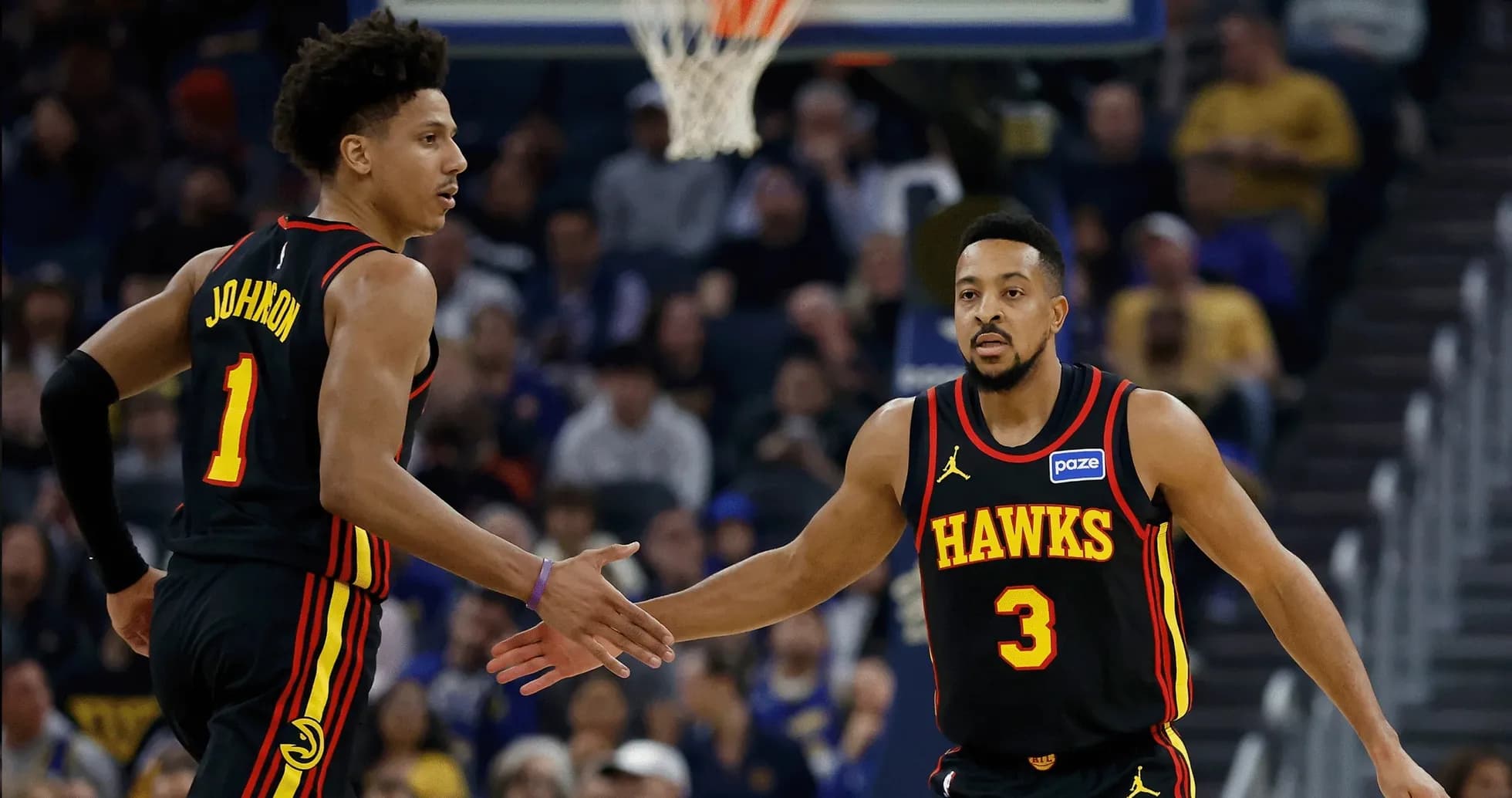
McCollum’s 18.7 points per game slotted in perfectly next to the two centerpieces of Atlanta’s next era: Jalen Johnson and Nickeil Alexander-Walker. With those three, the Hawks now have a trio hovering around 20 points per night, all capable of running offense and punishing mismatches in different ways.
Jalen Johnson’s Leap, Alexander-Walker’s Arrival
Johnson didn’t just “break out” last season. He detonated.
The versatile forward earned his first All-Star nod and his first All-NBA selection while averaging 22.5 points, 10.3 rebounds, 7.9 assists and 1.2 steals per game. Those are franchise-player numbers, and they came wrapped in the kind of two-way impact that coaches obsess over. Johnson became the engine of Quin Snyder’s system — a point forward who can grab the board, push the break, and either finish through contact or spray the ball to shooters.
On the perimeter, Alexander-Walker went from solid role player to Most Improved Player. His jump was as much about efficiency as volume: 20.8 points, 3.7 assists and 3.4 rebounds per game on 45.9% from the field, 39.9% from deep and 90.2% at the line. He turned into a three-level scorer who can also defend, and he did it while sharing the ball with Johnson and McCollum.
Put those two together, and Atlanta suddenly looks like a team with multiple primary options rather than one heliocentric star.
Defense, Threes, and Quin Snyder’s Blueprint
Snyder’s vision is clear. He wants a defense that digs into ball-handlers, jumps passing lanes and turns stops into runway. He also wants volume from beyond the arc — close to 40 three-point attempts per game.
The roster now fits that plan.
Dyson Daniels, Alexander-Walker and Luguentz Dort form a perimeter trio that can suffocate guards and wings. Dort’s arrival adds a blunt-force defensive presence Atlanta lacked in previous years. Daniels brings length and instincts. Alexander-Walker, once a question mark on that end, now plays with the confidence of a guard who knows he belongs.
Behind them, Onyeka Okongwu quietly posted 15.2 points, 7.6 rebounds and 3.1 assists per game, anchoring the middle with physicality and improved playmaking.
Atlanta finished last season 14th in offensive efficiency and 10th in defensive efficiency. Respectable. Not elite. The bet is that continuity, plus better defensive personnel and more shooting, nudges those rankings into contender territory.
And it’s easy to forget: this team led the eventual champion New York Knicks 2-1 in the first round. They had New York wobbling before the Knicks ripped off three straight wins and then stormed through the rest of the playoffs with just one more loss. Atlanta didn’t just see the title blueprint up close — they pushed it.
Depth as a Weapon
The starting five almost picks itself on paper: McCollum, Alexander-Walker, Daniels, Johnson and Okongwu. That group went 20-10 last season with a blistering plus-20.3 net rating. Now Snyder can add Dort and Aaron Wiggins to that mix.
And that’s where this Hawks team becomes genuinely interesting.
If that’s the starting unit, Snyder can bring Dort, Wiggins, Jock Landale, Zuby Ejiofor, Kingston Flemings, Asa Newell, Buddy Hield, Corey Kispert and Ryan Nembhard off the bench in varying combinations. That’s not just depth; that’s flexibility. Big, switchy lineups. Smaller, shooting-heavy groups. Defensive sledgehammer units with Dort and Daniels swallowing up ball-handlers.
Matchups will dictate a lot. So will training camp.
Snyder’s first task in the preseason is to lock in a starting lineup. His second is trickier: finding which players thrive as reserves and which need the rhythm of starting minutes. Dort and Wiggins, in particular, will test that calculus.
The backup power forward slot behind Johnson is also up for grabs, with Mouhamed Gueye, Newell and rookie Ejiofor battling for minutes. Flemings, the lottery pick, will draw eyes as he tries to soak up everything he can from McCollum and find a lane into the rotation.
Aaron Wiggins: The Quiet Wild Card
If there’s a breakout candidate hiding in plain sight, it’s Wiggins.
He already knows what it takes to win at the highest level. He played a valuable role in Oklahoma City’s 2025 championship and their run to the 2026 Western Conference Finals. But he never truly got the runway there. His career-high in minutes per game — 24.2 — came as a rookie in 2021-22. He’s averaged double figures in scoring just once, with 12.0 points per game in 2024-25.
The efficiency, though, has always been there. Wiggins is a 48.7% shooter from the field and a 38% shooter from three for his career. On a Hawks team that already shot the ball well from deep but craves even cleaner efficiency, that matters.
Give him more minutes, more touches, more freedom? Atlanta believes his scoring will climb. If it does, the second unit suddenly has a reliable, efficient wing scorer who can tilt games without hijacking possessions.
The Schedule’s Flashpoints
The regular season will test all of this depth and identity in sharp bursts.
On Oct. 21, the Hawks host the Orlando Magic in a Southeast Division clash that already feels like a measuring stick. The division is crowded; at least four teams see themselves as playoff locks. Last year, the top four were separated by just three games. Atlanta and Orlando finished 1-2. The tone gets set early.
Nov. 29 brings the Knicks back to Atlanta, along with the ghosts of that 2026 first-round series. The Hawks led 1-0 and 2-1. New York never looked like a future champion in that matchup — until it did. The Knicks took the next three, then lost only once more the rest of the postseason. Atlanta will remember.
Feb. 1 in Washington circles itself on every calendar in the city: Trae Young’s first game against the Hawks in Atlanta colors other than their own. The emotions will be raw, the stakes higher than the standings alone.
A week later, on Feb. 8, the Heat visit Atlanta in a game that could carry real weight in the division race. It lands just days before the Feb. 11 trade deadline, the kind of night that can push a front office toward aggression or patience.
And on April 4, the Hawks head to Philadelphia to face a star-laden 76ers group. It will be their eighth road game in an 11-game stretch as the regular season winds down — exactly the kind of late-season gauntlet that exposes pretenders and hardens contenders.
From Promise to Proof
Atlanta’s numbers after the All-Star break scream promise. The rotation screams depth. The system has clarity. The roster has balance.
What the Hawks don’t have yet is proof.
They’ve traded a singular star for a more democratic attack. They’ve added defenders who fit Snyder’s vision. They’ve watched Johnson and Alexander-Walker grow into legitimate top options and leaned on McCollum’s steady hand.
Now comes the question that will define their season: was that post-break surge a preview of a new power in the East, or just a hot streak on the way to something less?
The answer arrives over 82 games. And this time, Atlanta has no excuses — only opportunity.