Argentina Faces Sanctions After World Cup Final Brawl
The night that should have crowned a champion has instead spilled into a long, bitter aftermath for Argentina.
Their 1-0 defeat to Spain in the 2026 World Cup final has been eclipsed by the violent scenes that followed the final whistle, and FIFA has now delivered its verdict: sweeping, punishing, and aimed squarely at some of the Albiceleste’s most prominent figures.
Paredes hit hardest in post-final crackdown
Leandro Paredes has paid the steepest price. The 32-year-old midfielder has been handed a 10-match suspension and a £65,000 fine after FIFA reviewed his role in the chaotic brawl.
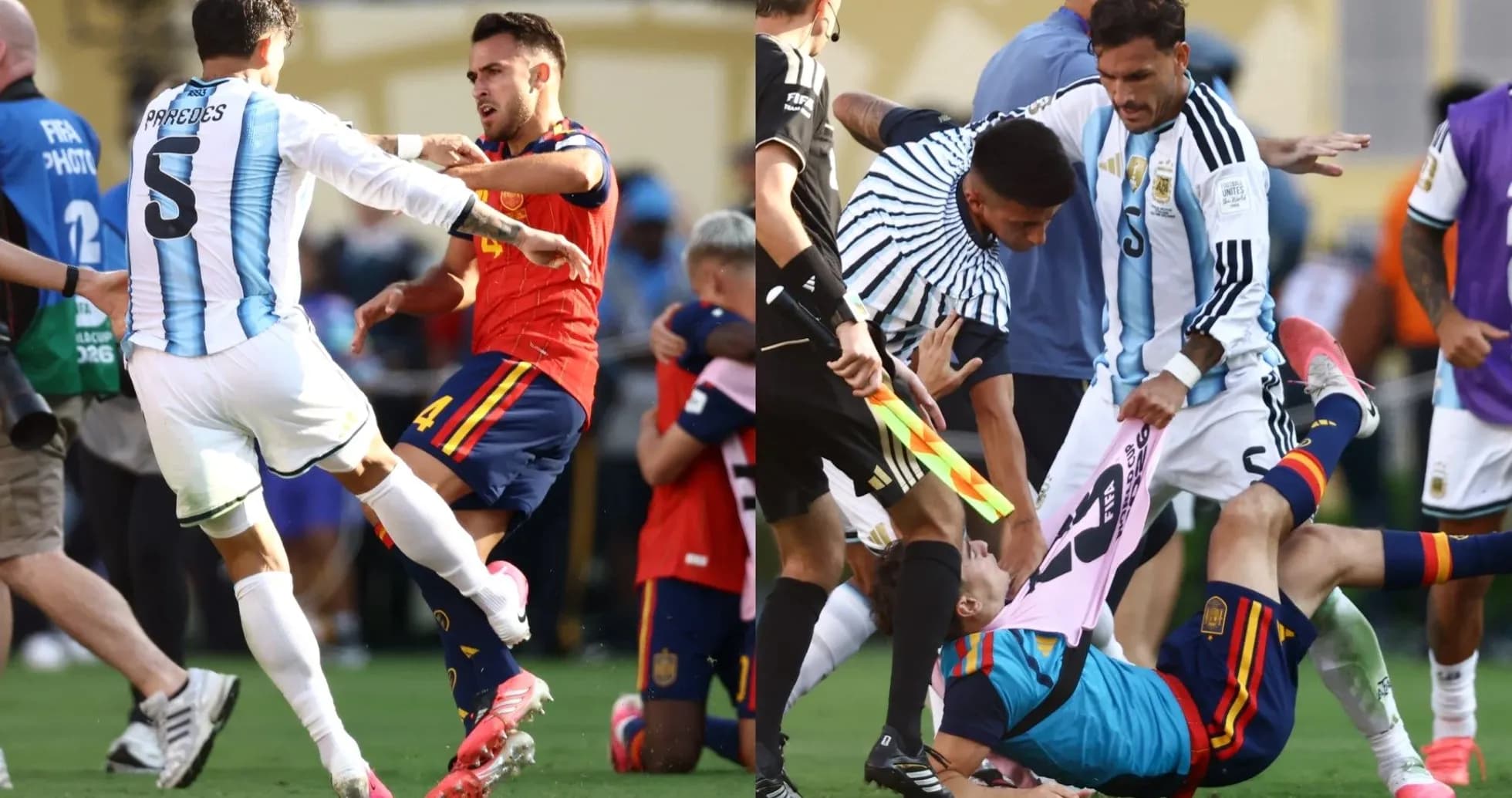
The charge sheet is stark. Paredes grabbed Eric Garcia by the throat, struck Gavi in the face, then shoved the Spanish teenager to the turf. In a final already heavy with tension, his actions became a flashpoint that FIFA was never likely to overlook.
Nahuel Molina has also been hit hard. The full-back received a seven-match ban for striking Spain captain Rodri in the torso, an incident that lit the fuse between the two sets of players and dragged almost everyone into the confrontation.
Thiago Almada and Gavi did not escape unscathed either. Both received one-match suspensions for their part in the melee, lesser punishments but still a formal mark against their names on football’s biggest stage.
Assistant coach Roberto Ayala is among the Argentine staff sanctioned as well, underlining how deep FIFA’s disciplinary net has been cast.
AFA moves fast to limit the damage
Argentina’s response has been swift and strategic.
The AFA released a statement confirming it had formally asked FIFA to allow the suspensions from the World Cup final – and the sanctions against the association itself – to be served in Class A friendlies and/or official matches, whichever comes first.
FIFA’s Disciplinary Committee has approved that request under current regulations. That decision changes everything.
Instead of watching key players miss competitive fixtures years down the line, Argentina can now burn through those bans in non-competitive games. Paredes’ 10 matches and Molina’s seven suddenly look more manageable if they are paid off in a packed calendar of friendlies.
The AFA is not stopping there. It stressed that, while the request over how the bans are served has been granted, it is still waiting for the written reasoning behind FIFA’s decisions. Once that arrives, the association intends to file appeals with FIFA’s Appeals Committee, with the Court of Arbitration for Sport (CAS) kept in reserve as a possible final step.
Argentina may be complying, but they are not conceding the argument.
Political flashpoint brings fresh punishment
The World Cup final brawl was not the only disciplinary cloud hanging over Argentina’s campaign.
After their semi-final win over England, several players – including Lionel Messi, Cristian Romero, Giovani Lo Celso and Lisandro Martinez – were filmed celebrating with a banner asserting that the Falkland Islands belong to Argentina. The image raced around the world and immediately drew calls for individual bans over what was seen as a political statement on the pitch.
Those calls have not translated into direct suspensions for the players involved. Instead, FIFA chose to punish the association. The AFA has been fined £235,000, with £73,000 of that amount suspended.
The sanctions do not end with money. Argentina will also face a partial stadium closure for their next two home matches, with attendances capped at 50 per cent. One of those match closures is suspended, but the message from FIFA is clear: the line between national sentiment and political provocation remains firmly policed.
Friendlies become Argentina’s escape route
For all the fines and closures, the key sporting question for Argentina is simple: when will their best players be back?
Here, the World Cup’s future format has handed them an unlikely advantage. As centenary co-hosts, Argentina already have a guaranteed place at the next World Cup. They do not need to navigate a qualifying campaign. They are in.
That removes the immediate risk of Paredes and Molina missing high-stakes qualifiers. It also creates a window of opportunity. With their next meaningful competitive fixtures not arriving until the 2028 Copa America, Argentina have time – and fixtures – to play with.
The expectation now is that the AFA will draw up a busy schedule of Class A international friendlies, using every available date to chip away at the bans. Each exhibition game brings Paredes and Molina one step closer to a clean slate and a full return to Lionel Scaloni’s plans.
The World Cup final may have ended in chaos and punishment, but the path back for Argentina’s sanctioned stars now runs through a long series of friendlies, half-full stadiums, and a national team trying to rebuild its image before the next great tournament arrives.